Advertisements
Advertisements
प्रश्न
Explain sexual reproduction in plants.
Advertisements
उत्तर
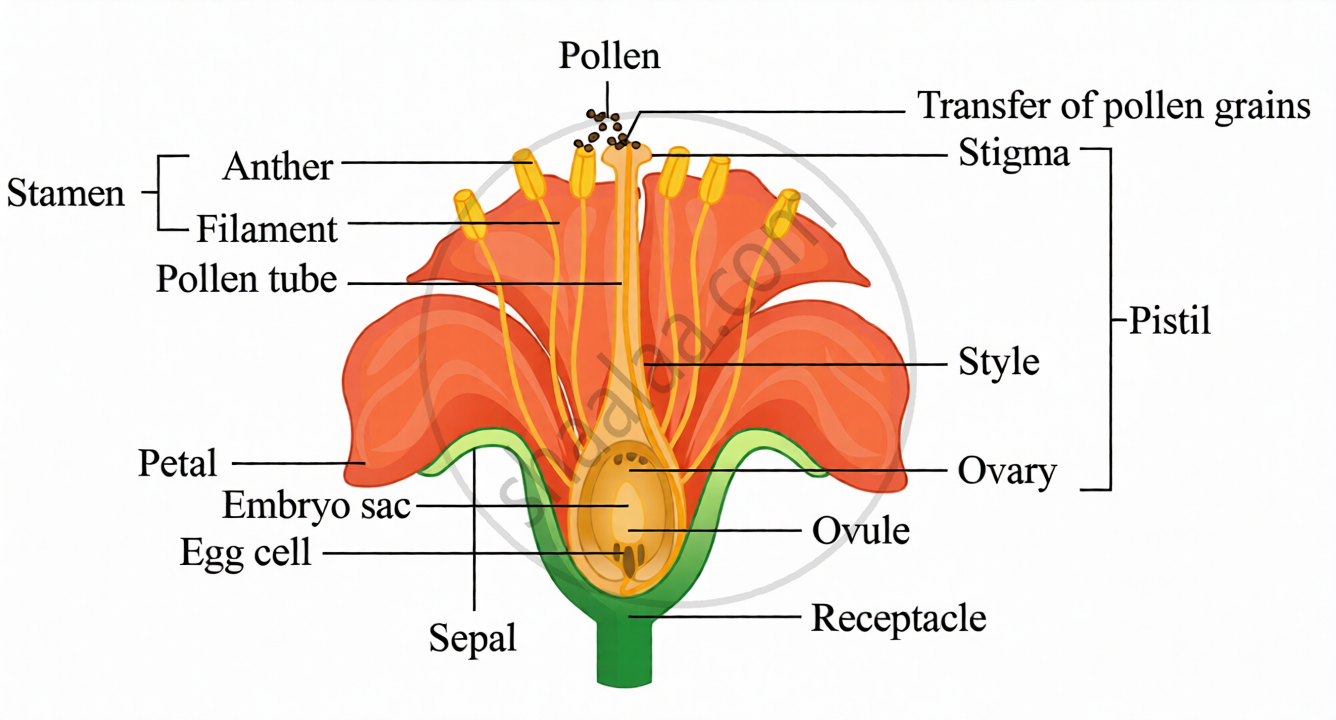
- In sexually reproducing plants, flowers function as the reproductive organs.
- In flowers, the male organ is the stamen and the female organ is the carpel.
- Flowers which have both the male and female organs, i.e. stamens and carpels, are called bisexual flowers, whereas flowers which have either male or female organs are called unisexual.
- Male gametes, called pollen grains, are produced by stamens, and carpels produce female gametes, called ovules or egg cells, inside ovaries.
- Fertilization takes place in the ovule where the egg cell and pollen grain fuse.
- This fertilized egg cell later develops into an embryo and the entire ovule gets converted into a seed.
- Under favourable conditions, the seed germinates to give rise to a new plant.
APPEARS IN
संबंधित प्रश्न
State significance of pollination.
State the function of flowers in the flowering plants.
Name the part made up of the stigma, style and ovary.
Where are the pollen grains produced?
What is the function of a flower?
What are the reproductive organs in a flower?
What is the name of female organ of a flower (other than carpel)?
Draw a neat sketch of the stamen of a flower. Mark in it filament and anther.
Explain the terms 'self pollination'
What type of plants reproduce by sexual reproduction method?
Describe the process of fertilisation in a flower with the help of labelled diagrams.
Which of the following statements are true for flowers?
(i) Flowers are always bisexual.
(ii) They contain sexual reproductive organs.
(iii) They are produced in all groups of plants.
(iv) after fertilization they give rise to fruits.
| When an insect sits on the flower of a plant then somene particles A present in the top of little stalks in the flower attach to its body hair. When this insect now sits on the flower of another similar plant, then particles A attached to the hair of insect are put on the top of a flask-shaped organ at the centre of flower. The particle A grows a long tube B from the top of flask-shaped organ through which C moves down and reaches the bottom part of flask-shaped organ. Here C fuses with the nucleus of D contained in structure E. The fusion of C and D forms a new cell F which grows and develops into a seed of the plant. |
- What are particles A? What is the process of transferring A from one flower to another flower of similar plant by the insect known as?
- What is the name of tube B?
- What is C which moves down through the tube B?
- Name D and E.
- What is F?
Put a tick mark (✓) against the correct alternative in the following statement
Reproductive whorls of a flower are:
Fill in the blank by selecting suitable word:
A flower that bears both the male and the female parts is known as __________ flower.
What is a flower ? Draw a neat labelled diagram showing the L.S. of a typical flower.
State whether the following statement is true (T) or false (F):
Stamens make egg cells.
What part is played by stamens and carpels in reproduction?
Draw a labelled diagram of a bisexual flower.
Distinguish between unisexual and bisexual flowers giving one example of each. Draw a diagram showing process of germination of pollen grains on stigma and label the following parts:
(a) Female germ cell
(b) Male germ cell
(c) Ovary
Draw a diagram of the longitudinal section of a flower and label on it sepal, petal, ovary and stigma.
Write the names of male and female reproductive parts of a flower.
What is phototropism?
Which of the following is not an unisexual flower?
a) Coconut
b) Papaya
c) Gulmohor
d) Maize
Prepare a slogan for campaign against female foeticide.
Differentiate between self-pollination and cross-pollination.
Bisexual : Hibiscus : : Unisexual : ___________
Pollen tube reaches the embryo sac via style.
Write the functions of sepals
Match the following
| 1. | Petal | Opuntia |
| 2. | Fern | Chrysanthemum |
| 3. | Phylloclade | Attracts insect |
| 4. | Hooks | Spore |
| 5. | Sucker | Bignonia |
Antipodal cells are present towards the ______ in an anatropous ovule.
Identify the female gametophyte in angiosperms.
Sperm and egg nuclei fuse due to ______.
Is the chromosome number of zygote, embryonal cells and adult of a particular organism always constant? How is the constancy maintained in these three stages?
State the number of sets of chromosomes present in a zygote.
Double fertilization means ______.
Sketch and label the essential and accessory whorls of flower.
What are the agents for pollination?
The pollen tube usually enters the embryo sac ______.
