Advertisements
Advertisements
प्रश्न
Collect the official data about present and a decade old population of various Asian countries and plot a graph of that data. With the help of it, draw your conclusions about demographic changes.
कृति
Advertisements
उत्तर
Population Changes in Various Asian Countries
Introduction
Population is an important factor in understanding a country's growth and development. Comparing current and decade-old population data helps us study demographic changes.| Country | Population (2014 | Population (2024) |
| India | 1.29 billion | 1.43 billion |
| China | 1.37 billion | 1.41 billion |
| Indonesia | 252 million | 281 million |
| Pakistan | 188 million | 241 million |
| Bangladesh | 159 million | 173 million |
| Japan | 127 million | 124 million |
Graph
Draw a double bar graph using the above data:
- X-axis: Countries
- Y-axis: Population
- Two bars for each country:
- 2014 Population
- 2024 Population
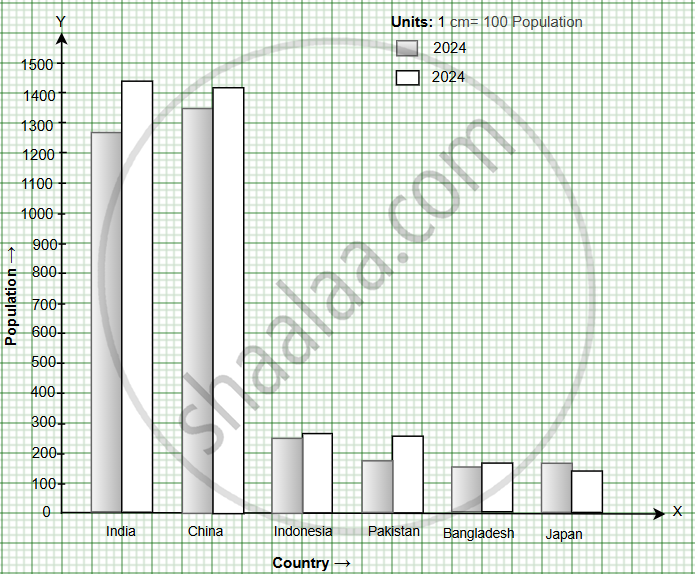
Observations
- Population has increased in most Asian countries over the last decade.
- India shows a significant increase in population.
- Pakistan and Indonesia have experienced rapid population growth.
- China’s population growth has been comparatively slow.
- Japan shows a slight decline in population.
Conclusions
- Most Asian countries are experiencing population growth.
- Developing countries generally have higher population growth rates than developed countries.
- An increased population puts pressure on resources, healthcare, education, and employment.
- Countries with declining populations may face challenges related to an ageing population and labour shortages.
- Demographic changes play an important role in the social and economic development of a country.
Thus, the graph indicates that while population growth continues in most Asian countries, some countries are experiencing slower growth or population decline, leading to significant demographic changes.
shaalaa.com
क्या इस प्रश्न या उत्तर में कोई त्रुटि है?
