Advertisements
Advertisements
प्रश्न
A student is observing the temporary mount of a leaf peel under a microscope. Draw a labelled diagram of the structure of stomata as seen under the microscope
Advertisements
उत्तर
Structure of stomata
APPEARS IN
संबंधित प्रश्न
| When an insect sits on the flower of a plant then somene particles A present in the top of little stalks in the flower attach to its body hair. When this insect now sits on the flower of another similar plant, then particles A attached to the hair of insect are put on the top of a flask-shaped organ at the centre of flower. The particle A grows a long tube B from the top of flask-shaped organ through which C moves down and reaches the bottom part of flask-shaped organ. Here C fuses with the nucleus of D contained in structure E. The fusion of C and D forms a new cell F which grows and develops into a seed of the plant. |
- What are particles A? What is the process of transferring A from one flower to another flower of similar plant by the insect known as?
- What is the name of tube B?
- What is C which moves down through the tube B?
- Name D and E.
- What is F?
Draw a labelled diagram of a bisexual flower.
Identify A, B, C and D in the given diagram and write their names.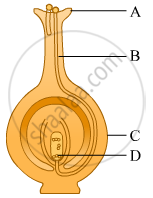
Write the names of male and female reproductive parts of a flower.
Mention pollination types.
Distinguish between self-pollination and cross-pollination.
Write the events involved in the sexual reproduction of a flowering plant.
Discuss the first event and write the types.
Generally, in a pollen tube, which of the following moves to the tip of the tube?
Conidia are formed endogenously while zoospores are formed endogenously.
Give any two examples of agents of pollination.
