Advertisements
Advertisements
Question
Explain sexual reproduction in plants.
Advertisements
Solution
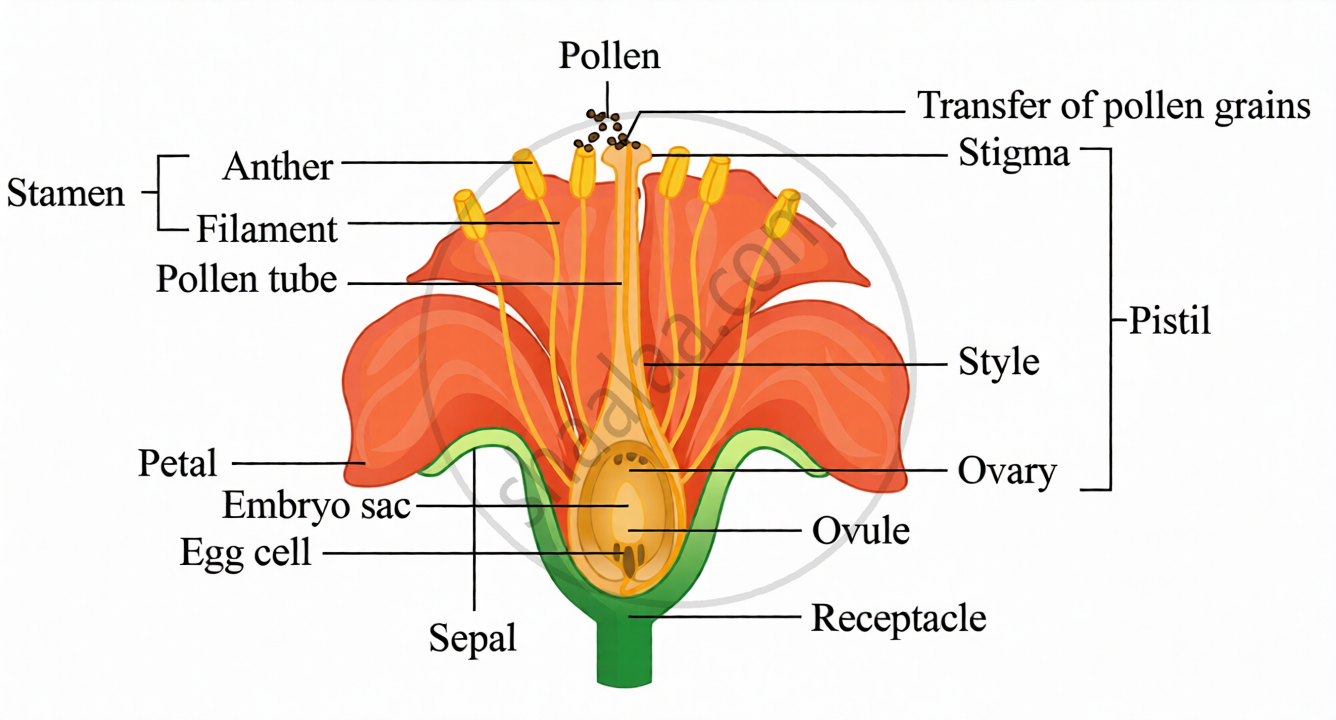
- In sexually reproducing plants, flowers function as the reproductive organs.
- In flowers, the male organ is the stamen and the female organ is the carpel.
- Flowers which have both the male and female organs, i.e. stamens and carpels, are called bisexual flowers, whereas flowers which have either male or female organs are called unisexual.
- Male gametes, called pollen grains, are produced by stamens, and carpels produce female gametes, called ovules or egg cells, inside ovaries.
- Fertilization takes place in the ovule where the egg cell and pollen grain fuse.
- This fertilized egg cell later develops into an embryo and the entire ovule gets converted into a seed.
- Under favourable conditions, the seed germinates to give rise to a new plant.
APPEARS IN
RELATED QUESTIONS
What is pollination?

(i) Name the part marked 'A' in the diagram.
(ii) How dose 'A' reachese part 'B'?
(iii) State the importance of the part 'C'.
(iv) What happens to the part marked 'D' after fertilisation is over?
A student while observing an embryo of a pea seed in the laboratory listed various parts of the embryo as given below:
Testa, Tegmen, Radicle, Plumule, Micropyle, Cotyledon.
On examining the list the teacher remarked that only three parts are correct. Select three correct parts from the above list:
(a) Testa, Radicle, Cotyleddon
(b) Tegmen, Radicle, Micropyle
(c) Cotyledon, Plumule, Testa
(d) Radicle, Cotyledon, Plumule
A student identified the various parts of an embryo of a gram seed and listed them as given below :
(I) Testa
(II) Plumule
(III) Radicle
(IV) Cotyledon
(V) Tegmen
Out of these the actual parts of the embryo are :
(A) I, II, III
(B) II, III, IV
(C) III, IV, V
(D) II, IV, V
Name the parts labelled as A, B, C and D in the diagram given below:

Explain what you understand by sexual reproduction.
Sketch the reproductive parts of a flower.
How does the process of fertilisation take place in flowers?
What is the name of female part of a flower?
Fill in the following blank with suitable word :
The ovule becomes a .......... after fertilisation.
Fill in the following blank with suitable word :
Flowering plants reproduce by ...........method of reproduction.
Draw a neat sketch of the stamen of a flower. Mark in it filament and anther.
Explain the terms 'self pollination'
Name the part of a seed which grows into root.
Name the part of a seed which grows into shoot.
Which of the following is the correct sequence of events of sexual reproduction in a flower?
(a) pollination, fertilisation, seed, embryo
(b) seed, embryo, fertilisation, pollination
(c) pollination, fertilisation, embryo, seed
(d) embryo, seed, pollination, fertilisation
The length of pollen tube depends on the distance between :
(a) pollen grain and upper surface of stigma
(b) pollen grain on upper surface of stigma and ovule
(c) pollen grain in anther and upper surface of stigma
(d) upper surface of stigma and lower part of style
Which of the following statements are true for flowers?
(i) Flowers are always bisexual.
(ii) They contain sexual reproductive organs.
(iii) They are produced in all groups of plants.
(iv) after fertilization they give rise to fruits.
Which of the following statements are true for sexual reproduction in flowering plants?
(i) it requires two types of gametes
(ii) fertilisation is a compulsory event
(iii) it always results in the formation of zygote
(iv) offsprings formed are clones
(a) (i) and (iv)
(b) (i), (ii) and (iv)
(c) (i), (ii) and (iii)
(d) (ii), (iii) and (iv)
The correct sequence of reproductive stages occurring in flowering plants is ______.
Put a tick mark (✓) against the correct alternative in the following statement
Pollen is produced in the:
Mention the function of Flower.
Draw a diagram of the longitudinal section of a flower and label on it sepal, petal, ovary and stigma.
Find the odd one out:
Define.
Inflorescence
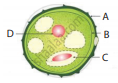
Identify the parts A, B, C, and D?
In which part of the flower germination of pollen grains takes place?
In which of the following manner the arrangement of megaspores in a tetrad is observed in angiosperms?
What would be the number of chromosomes in the cells of the aleurone layer in a plant species with 8 chromosomes in its synergids?
The seed that contains the future plant is called the ______
Length of pollen tube depends on the distance between ______
Which out of the following processes does not lead to the formation of clones.
Which among the following statements are true for unisexual flowers?
- They possess both stamen and pistil
- They possess either stamen or pistil
- They exhibit cross pollination
- Unisexual flowers possessing only stamens cannot produce fruits
Which among the following statements are true for sexual reproduction in flowering plants?
- It requires two types of gametes
- Fertilisation is a compulsory event
- It always results in formation of zygote
- Offspring formed are clones
In a bisexual flower inspite of the young stamens being removed artificially, the flower produces fruit. Provide a suitable explanation for the above situation.
The ovaries of different flowers may contain ______.
Type of sexual reproduction is ______.
The pollen tube usually enters the embryo sac ______.
The number of pollen sacs in a dithecous anther is ______.
