Advertisements
Advertisements
Question
Give scientific reason.
Fertilization in plants is called double fertilization.
Advertisements
Solution
- The pollen grain germinates over the stigma and gives rise to pollen tube.
- The pollen tube bursts and releases two male gametes in the embryo sac.
- One male gamete fuses with the egg cell to form the zygote, whereas the second male gamete fuses with two polar nuclei in the embryo sac to form an endosperm.
- Since, in flowering plants, the process of fertilization occurs twice in the same embryo sac, by two male gametes, it is called as double fertilization.
APPEARS IN
RELATED QUESTIONS
A student identified the various parts of an embryo of a gram seed and listed them as given below :
(I) Testa
(II) Plumule
(III) Radicle
(IV) Cotyledon
(V) Tegmen
Out of these the actual parts of the embryo are :
(A) I, II, III
(B) II, III, IV
(C) III, IV, V
(D) II, IV, V
Mention the changes a flower undergoes after fertilisation.
You are asked by your teacher to study the different parts of an embryo of a gram seed. Given below are the steps to be followed for the experiment:
I. Soak the gram seeds in plain water and keep them overnight.
II. Cut open a soaked seed and observe its different parts.
III. Take some dry gram seeds in a petri dish.
IV. Drain the excess water.
V. Cover the soaked seeds with a wet cotton cloth and leave them for a day.
The correct sequence of these steps is :
(A) III, I, V, IV, II
(B) III, I, II, IV, V
(C) III, IV, V, I, II
(D) III, I, IV, V, II
The fusion of male and female gametes is termed as ______.
Name the part made up of the stigma, style and ovary.
Fill in the following blank with suitable word :
Flowering plants reproduce by ...........method of reproduction.
Draw a neat sketch of the carpel of a flower. Mark in it stigma, style and ovary.
What is made in ovary of a flower?
What changes take place in the flower after fertilisation which lead to the formation of seeds and fruit?
Draw a neat diagram of a flower showing its various parts. In this diagram mark stem, receptacle, sepals, petals, stamen and carpel.
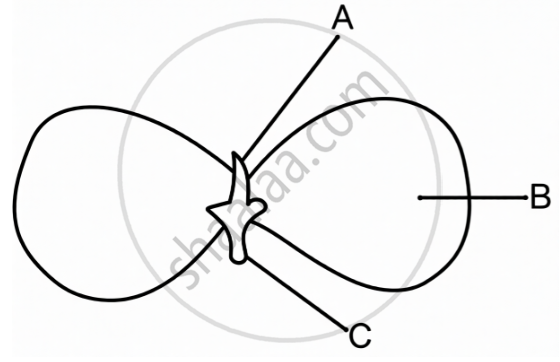
In the figure given alongside, the parts marked A, B and C are sequentially:
The correct sequence of reproductive stages occurring in flowering plants is ______.
The flask-shaped organ A at the centre of a flower is surrounded by a number of little stalks B having swollen tops which lie just inside the ring of petals.
(a) Name A. What are the various parts of A?
(b) Which part of A contains gametes?
(c) Name B. What is the swollen top of B known as?
(d) What does the swollen top of b contain?
(e) Out of A and B, which one is (i) male part, and (ii) female part of the flower?
Multiple choice question. Tick (✓) the correct choice:
Unisexual flowers are found in
- mulberry
- mustard
- pea
- sunflower
State whether the following statement is true (T) or false (F):
Stamens make egg cells.
Draw a diagram of the longitudinal section of a flower and label on it sepal, petal, ovary and stigma.
Identify the odd. Stigma, Style, Pollen, Ovary.
Fill in the blanks and rewrite the completed statements:
Lymph flows in _______________ direction.
Answer the following question.
How does suitable pollination lead to fertilization?
Pollen tube reaches the embryo sac via style.
Write the functions of sepals
Give scientific reason.
Flower is a structural unit of sexual reproduction in plants.
Match the following
| 1. | Petal | Opuntia |
| 2. | Fern | Chrysanthemum |
| 3. | Phylloclade | Attracts insect |
| 4. | Hooks | Spore |
| 5. | Sucker | Bignonia |
The essential parts of a flower are ______.
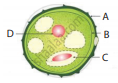
Identify the parts A, B, C, and D?
Which of the following are the chemical components of the wall of pollen tube?
Which of the following is the outermost protective layer of anther?
Generally, in a pollen tube, which of the following moves to the tip of the tube?
How many middle layers are generally present in the wall of the anther lobes?
Which type of development is observed in male gametophytes of plants?
Identify the female gametophyte in angiosperms.
What would be the number of chromosomes in the cells of the aleurone layer in a plant species with 8 chromosomes in its synergids?
Variations occur as a result of ______
Where is the zygote located in the flower after fertilization?
Draw the diagram of a flower and label the four whorls. Write the names of gamete producing organs in the flower.
State the number of sets of chromosomes present in a zygote.
In a plant flower the female whorl is ______.
The figure below shows the concept of double fertilization. Complete the flow chart showing the progress at each step:

State the post-fertilisation changes that lead to fruit formation in plants.
