Advertisements
Advertisements
Question
The students of a class were asked by the teacher to study the different parts of an embryo of an angiosperm. Given below are the essential steps for the experiment :
A. Soak the seeds in plain water and keep them overnight.
B. Cut open the soaked seed and observe its different parts.
C. Take some healthy seeds in a petri-dish.
D. Drain the excess water, cover the seeds with a wet cotton cloth and leave them as it is for a day.
The correct sequence of these steps is
(a) C, A, D, B
(b) C, D, A, B
(c) A, C, D, B
(d) A, C, B, D
Advertisements
Solution
The correct sequence for this experiment should be
C→A→ D → B
Hence, the correct answer is option (a).
APPEARS IN
RELATED QUESTIONS
How does fertilisation occur in flowers? Name the parts of the flower that develop into (i) seed, and (ii) fruit after fertilisation.
The anther contains ______.
Where are the pollen grains produced?
Give one example each of unisexual and bisexual flowers. Differentiate between the two types of pollination that occur in flowers. What happens when a pollen lands on a suitable stigma? Write about the events that occur till the seed formation in the ovary.
Identify A, B, C and D in the given diagram and write their names.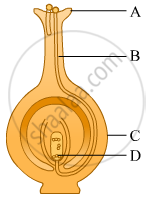
Match the following
| 1. | Petal | Opuntia |
| 2. | Fern | Chrysanthemum |
| 3. | Phylloclade | Attracts insect |
| 4. | Hooks | Spore |
| 5. | Sucker | Bignonia |
Which among the following statements are true for unisexual flowers?
- They possess both stamen and pistil
- They possess either stamen or pistil
- They exhibit cross pollination
- Unisexual flowers possessing only stamens cannot produce fruits
In a bisexual flower inspite of the young stamens being removed artificially, the flower produces fruit. Provide a suitable explanation for the above situation.
What is the structural unit of sexual reproduction in plant?
Explain the post fertilization changes that occur in the ovary of a flower.
