Advertisements
Advertisements
Question
What is the structural unit of sexual reproduction in plant?
Advertisements
Solution
Flower is the structural unit of the sexual reproduction in plant.
APPEARS IN
RELATED QUESTIONS
A student was asked to observe and identify the various parts of an embryo of a red kidney bean seed. He identified the parts and listed them as under:
I. Tegmen
II. Testa
III. Cotyledon
IV. Radicle
V. Plumule
The correctly identified parts among these are
(A) I, II and III
(B) II, III and IV
(C) III, IV and V
(D) I, III, IV and V
Name the parts A, B and C shown in the diagram and write their functions.

Name the parts labelled as A, B, C and D in the diagram given below:-

What is pollination?
"The chromosomal number of the sexually producing parents and their offspring is the same." Justify this statement.
You are asked by your teacher to study the different parts of an embryo of a gram seed. Given below are the steps to be followed for the experiment:
I. Soak the gram seeds in plain water and keep them overnight.
II. Cut open a soaked seed and observe its different parts.
III. Take some dry gram seeds in a petri dish.
IV. Drain the excess water.
V. Cover the soaked seeds with a wet cotton cloth and leave them for a day.
The correct sequence of these steps is :
(A) III, I, V, IV, II
(B) III, I, II, IV, V
(C) III, IV, V, I, II
(D) III, I, IV, V, II
Sketch the reproductive parts of a flower.
Name the male part of the flower.
Fill in the following blank with suitable word :
The female organ of reproduction in the flower is the...........
How do the insects help in cross-pollination?
Give some examples of different modes of fertilisation in nature?
In tobacco plant, the male gametes have 24 chromosomes.
What is the number of chromosomes in the female gamete?
The part of a seed which grows and develops into root on germination is :
(a) cotyledon
(b) plumule
(c) follicle
(d) radicle
The flask-shaped organ A at the centre of a flower is surrounded by a number of little stalks B having swollen tops which lie just inside the ring of petals.
(a) Name A. What are the various parts of A?
(b) Which part of A contains gametes?
(c) Name B. What is the swollen top of B known as?
(d) What does the swollen top of b contain?
(e) Out of A and B, which one is (i) male part, and (ii) female part of the flower?
Fill in the blank:
Seeds are formed from________.
Explain the process of fertilisation in flowers.
A student is asked to study the different parts of an embryo of pea seeds. Given below are the essential steps for the experiment :
(I) Soak the pea seeds in plain water and keep them overnight.
(II) Cut open the soaked seed and observe its different parts.
(III) Take some pea seeds in a petri dish.
(IV) Drain the excess water. Cover the seeds with a wet cotton cloth and leave them as it is for a day.
The correct sequence of these steps is
(A) III, I, IV, II
(B) III, IV, I, II
(C) III, I, II, IV
(D) III, II, I, IV
Write the names of male and female reproductive parts of a flower.
Sketch the labelled diagram.
Flower with its sexual reproductive organs.
Fill in the blank by selecting suitable word:
Transfer of pollen grains from the anther to the stigma is known as______________.
Differentiate between self-pollination and cross-pollination.
What is cleistogamy? Write one advantage and one disadvantage of it, to the plant.
Give scientific reason.
Flower is a structural unit of sexual reproduction in plants.
The male reproductive part of a flower is ______.
Identify the parts A, B, C, and D?
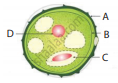
Write the events involved in the sexual reproduction of a flowering plant.
a. Discuss the first event and write the types.
b. Mention the advantages and the disadvantages of that event.
In which part of the flower germination of pollen grains takes place?
Where does the endothecium layer of anther lobes is present?
The ovule of an angiosperm is technically equivalent to ______
How many middle layers are generally present in the wall of the anther lobes?
Flowers showing ornithophily show few characteristic like ______.
Pineapple fruit develops from ______.
The flower of the Hibiscus plant is ______
Which among the following statements are true for unisexual flowers?
- They possess both stamen and pistil
- They possess either stamen or pistil
- They exhibit cross pollination
- Unisexual flowers possessing only stamens cannot produce fruits
Which among the following statements are true for sexual reproduction in flowering plants?
- It requires two types of gametes
- Fertilisation is a compulsory event
- It always results in formation of zygote
- Offspring formed are clones
Trace the path a male gamete takes to fertilise a female gamete after being released from the penis.
Double fertilization is exhibited by ______
