Advertisements
Advertisements
प्रश्न
What is the structural unit of sexual reproduction in plant?
Advertisements
उत्तर
Flower is the structural unit of the sexual reproduction in plant.
APPEARS IN
संबंधित प्रश्न
A student has to perform the experiment "To identify the different parts of an embryo of a dicot seed." Select from the following an appropriate group of seeds:
(a) Pea, gram, wheat
(b) Red kidney bean, maize, gram
(c) Maize, wheat, red kidney bean
(d) Red kidney bean, pea, gram
Write the names of those parts of a flower which serve the same function as the following do in the animals :
(i) testis,
(ii) sperm,
(iii) ovary,
(iv) egg
The fusion of male and female gametes is termed as ______.
Sketch the reproductive parts of a flower.
How does the process of fertilisation take place in flowers?
Name the part made up of the stigma, style and ovary.
Name the male part of the flower.
Where are a plant's sex organs located?
What is the name of female part of a flower?
Draw a neat sketch of the carpel of a flower. Mark in it stigma, style and ovary.
What is made in anther of a flower?
How do the insects help in cross-pollination?
Explain the term 'fertilisation'.
Give some examples of different modes of fertilisation in nature?
What type of plants reproduce by sexual reproduction method?
Name the part of a seed which grows into shoot.
In tobacco plant, the male gametes have 24 chromosomes.
What is the number of chromosomes in the female gamete?
What is meant by ‘unisexual flowers’?
One of the following occurs in the reproductive system of flowering plants as well as that of humans. This is :
(a) vas deferens
(b) anther
(c) ovary
(d) style
In the figure given alongside, the parts marked A, B and C are sequentially:
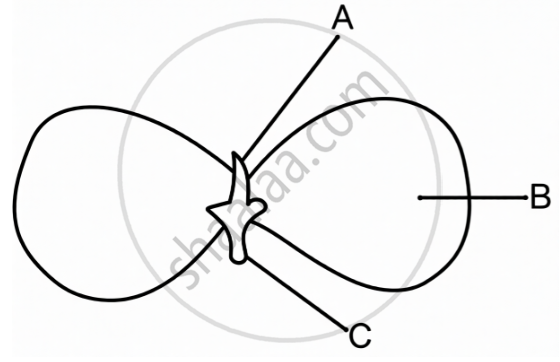
What is a flower ? Draw a neat labelled diagram showing the L.S. of a typical flower.
Multiple choice question. Tick (✓) the correct choice:
Unisexual flowers are found in
- mulberry
- mustard
- pea
- sunflower
Multiple choice question. Tick (✓) the correct choice:
The male gamete is present inside the which germinates.
- the style
- the stigma
- the anther
- the ovary
Fill in the blanks:
A carpel consists of ________ , ________ and ________.
Mention the function of Flower.
(a) Identify A, B and C in the given diagram and write their functions.
(b) Mention the role of gamete and zygote in sexually reproducing organisms.
In the figure, the parts marked A, B and C are sequentially:

(A) Plumule, Radicle and Cotyledon
(B) Radicle, Plumule and Cotyledon
(C) Plumule, Cotyledon and Radicle
(D) Radicle, Cotyledon and Plumule
What is phototropism?
List any two differences between pollination and fertilization.
Explain sexual reproduction in plants.
Prepare a slogan for campaign against female foeticide.
Draw a diagram of the longitudinal section of a flower and label the following parts.
What is meant by pollination?
Answer the following question.
List two agents of pollination?
Give scientific reason.
Flower is a structural unit of sexual reproduction in plants.
The essential parts of a flower are ______.
Which among the following statements are true for unisexual flowers?
- They possess both stamen and pistil
- They possess either stamen or pistil
- They exhibit cross pollination
- Unisexual flowers possessing only stamens cannot produce fruits
Sexual maturation of reproductive tissues and organs are necessary link for reproduction. Elucidate.
