Advertisements
Advertisements
प्रश्न
Type of sexual reproduction is ______.
विकल्प
Fragmentation
Regeneration
Gamete formation
Budding
Advertisements
उत्तर
Type of sexual reproduction is Gamete formation.
Explanation:
Sexual reproduction is always accomplished with the assistance of two germ cells. Those two germ cells are female gametes and male gametes. Meiosis is the process by which gametes are formed. The number of chromosomes is reduced to half during meiosis, resulting in the formation of haploid gametes.
Notes
Gamete formation is a process involved in sexual reproduction. It is not a type of sexual reproduction.
APPEARS IN
संबंधित प्रश्न
Give one example of a unisexual flower.
Write the names of those parts of a flower which serve the same function as the following do in the animals :
(i) testis,
(ii) sperm,
(iii) ovary,
(iv) egg
Explain what you understand by sexual reproduction.
The reproductive part of a plant is the ______.
Name the swollen lower part of the carpel.
Fill in the following blank with suitable word :
The ovary of a flower becomes ....... after fertilisation.
Fill in the following blank with suitable word :
Flowering plants reproduce by ...........method of reproduction.
Fill in the following blank with suitable word :
The male organ of reproduction in the flower is the.......... .
How do the insects help in cross-pollination?
Name the part of a seed which grows into root.
What is meant by ‘unisexual flowers’?
One of the following occurs in the reproductive system of flowering plants as well as that of humans. This is :
(a) vas deferens
(b) anther
(c) ovary
(d) style
Which among the following statements are true for unisexual flowers?
(i) They possess both stamen and pistil
(ii) They possess either stamen or pistil
(iii) They exhibit cross pollination
(iv) Unisexual flower possessing only stamens cannot produce fruits
(a) (i) and (iv)
(b) (ii), (iii) and (iv)
(c) (ii) and (iii)
(d) (i), (iii) and (iv)
Find the odd-one out, giving reason:
Anther, pollen grain, ovule male gamete
Mention the function of Stigma.
Identify A, B, C and D in the given diagram and write their names.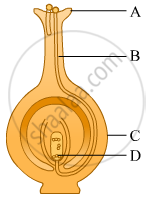
“Cell division is a type of reproduction in unicellular organism.” Justify.
Distinguish between unisexual and bisexual flowers giving one example of each. Draw a diagram showing process of germination of pollen grains on stigma and label the following parts:
(a) Female germ cell
(b) Male germ cell
(c) Ovary
List any two differences between pollination and fertilization.
Explain sexual reproduction in plants.
Fill in the blanks and rewrite the completed statements:
Lymph flows in _______________ direction.
Define.
Inflorescence
The male reproductive part of a flower is ______.
Which of the following are the chemical components of the wall of pollen tube?
Antipodal cells are present towards the ______ in an anatropous ovule.
Generally, in a pollen tube, which of the following moves to the tip of the tube?
The 3-celled egg apparatus at the micropylar end comprises of ______
What would be the number of chromosomes of the aleurone cells of a plant with 42 chromosomes in its roots tip cells?
Sperm and egg nuclei fuse due to ______.
Conidia are formed endogenously while zoospores are formed endogenously.
Which among the following statements are true for unisexual flowers?
- They possess both stamen and pistil
- They possess either stamen or pistil
- They exhibit cross pollination
- Unisexual flowers possessing only stamens cannot produce fruits
Where is the zygote located in the flower after fertilization?
Trace the path a male gamete takes to fertilise a female gamete after being released from the penis.
Sketch and label the essential and accessory whorls of flower.
The figure below shows the concept of double fertilization. Complete the flow chart showing the progress at each step:

