Advertisements
Advertisements
प्रश्न
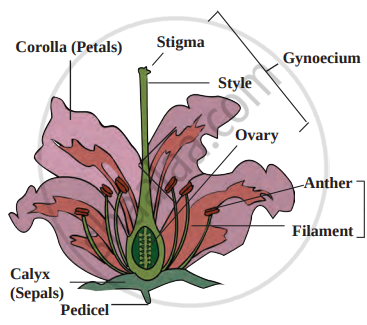
Sketch and label the essential and accessory whorls of flower.
Advertisements
उत्तर
संबंधित प्रश्न
State significance of pollination.
Name and differentiate between the two modes of pollination in flowering plants.
A student identified the various parts of an embryo of a gram seed and listed them as given below :
(I) Testa
(II) Plumule
(III) Radicle
(IV) Cotyledon
(V) Tegmen
Out of these the actual parts of the embryo are :
(A) I, II, III
(B) II, III, IV
(C) III, IV, V
(D) II, IV, V
Name the parts labelled as A, B, C and D in the diagram given below:

Give one example of a unisexual flower.
State the function of flowers in the flowering plants.
Sketch the reproductive parts of a flower.
How does the process of fertilisation take place in flowers?
State the name of the functional unit concerned with sexual reproduction.
Fill in the following blank with suitable word :
The female organ of reproduction in the flower is the...........
Explain the terms 'cross-pollination'?
What changes take place in the flower after fertilisation which lead to the formation of seeds and fruit?
One of the following occurs in the reproductive system of flowering plants as well as that of humans. This is :
(a) vas deferens
(b) anther
(c) ovary
(d) style
The part of a seed which grows and develops into root on germination is :
(a) cotyledon
(b) plumule
(c) follicle
(d) radicle
Put a tick mark (✓) against the correct alternative in the following statement
Pollen is produced in the:
State whether the following statement is true (T) or false (F):
Flowers which possess stamens and carpel are called unisexual.
Mention the function of Anther.
Identify A, B, C and D in the given diagram and write their names.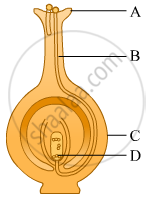
Draw a diagram of the longitudinal section of a flower and label on it sepal, petal, ovary and stigma.
Which of the following is not an unisexual flower?
a) Coconut
b) Papaya
c) Gulmohor
d) Maize
Explain sexual reproduction in plants.
Prepare a slogan for campaign against female foeticide.
Mention pollination types.
What is cleistogamy? Write one advantage and one disadvantage of it, to the plant.
Find the odd one out:
Define.
Inflorescence
Write the functions of sepals
Give scientific reason.
Fertilization in plants is called double fertilization.
Which of the following are the chemical components of the wall of pollen tube?
Which type of development is observed in male gametophytes of plants?
Which among the following statements are true for unisexual flowers?
- They possess both stamen and pistil
- They possess either stamen or pistil
- They exhibit cross pollination
- Unisexual flowers possessing only stamens cannot produce fruits
Give reason for the following:
Fertilization cannot take place in flowers if pollination does not occur.
Draw the diagram of a flower and label the four whorls. Write the names of gamete producing organs in the flower.
State the number of sets of chromosomes present in a zygote.
Double fertilization means ______.
What are the agents for pollination?
The figure below shows the concept of double fertilization. Complete the flow chart showing the progress at each step:

Sexual maturation of reproductive tissues and organs are necessary link for reproduction. Elucidate.
Type of sexual reproduction is ______.
