Advertisements
Advertisements
प्रश्न
Mention pollination types.
Explain the different types of pollination.
Advertisements
उत्तर
- Self-pollination: It is the transfer of pollen grains from the anther to the stigma of the same flower or another flower on the same plant.
- Cross-pollination: It is the transfer of pollen grains from the anther to the stigma of the flower present on two different plants.
APPEARS IN
संबंधित प्रश्न
A student while observing an embryo of a pea seed in the laboratory listed various parts of the embryo as given below:
Testa, Tegmen, Radicle, Plumule, Micropyle, Cotyledon.
On examining the list the teacher remarked that only three parts are correct. Select three correct parts from the above list:
(a) Testa, Radicle, Cotyleddon
(b) Tegmen, Radicle, Micropyle
(c) Cotyledon, Plumule, Testa
(d) Radicle, Cotyledon, Plumule
A student identified the various parts of an embryo of a gram seed and listed them as given below :
(I) Testa
(II) Plumule
(III) Radicle
(IV) Cotyledon
(V) Tegmen
Out of these the actual parts of the embryo are :
(A) I, II, III
(B) II, III, IV
(C) III, IV, V
(D) II, IV, V
Give one example of a unisexual flower.
How is the process of pollination different from fertilization?
Where are the pollen grains produced?
Where are a plant's sex organs located?
What is the name of female organ of a flower (other than carpel)?
Fill in the following blank with suitable word :
Ovules contain ......... gametes of a plant.
Fill in the following blank with suitable word :
Flowering plants reproduce by ...........method of reproduction.
Give some examples of different modes of fertilisation in nature?
Name the part of a seed which grows into root.
In tobacco plant, the male gametes have 24 chromosomes.
What is the number of chromosomes in the female gamete?
Describe the process of fertilisation in a flower with the help of labelled diagrams.
Which of the following is the correct sequence of events of sexual reproduction in a flower?
(a) pollination, fertilisation, seed, embryo
(b) seed, embryo, fertilisation, pollination
(c) pollination, fertilisation, embryo, seed
(d) embryo, seed, pollination, fertilisation
The length of pollen tube depends on the distance between :
(a) pollen grain and upper surface of stigma
(b) pollen grain on upper surface of stigma and ovule
(c) pollen grain in anther and upper surface of stigma
(d) upper surface of stigma and lower part of style
Put a tick mark (✓) against the correct alternative in the following statement
Pollen is produced in the:
Fill in the blank by selecting suitable word:
A flower that bears both the male and the female parts is known as __________ flower.
Fill in the blanks:
A stamen consists of ______ and ________.
Find the odd-one out, giving reason:
Anther, pollen grain, ovule male gamete
What are the male and female gametes in a flowering plant?
In the figure, the parts marked A, B and C are sequentially:

(A) Plumule, Radicle and Cotyledon
(B) Radicle, Plumule and Cotyledon
(C) Plumule, Cotyledon and Radicle
(D) Radicle, Cotyledon and Plumule
“Cell division is a type of reproduction in unicellular organism.” Justify.
Distinguish between unisexual and bisexual flowers giving one example of each. Draw a diagram showing process of germination of pollen grains on stigma and label the following parts:
(a) Female germ cell
(b) Male germ cell
(c) Ovary
What is phototropism?
Draw a diagram of the longitudinal section of a flower and label the following parts.
Answer the following question.
How does suitable pollination lead to fertilization?
A student is observing the temporary mount of a leaf peel under a microscope. Draw a labelled diagram of the structure of stomata as seen under the microscope
Accessory whorls : Calyx and corolla : : essential whorls : ______________
Give scientific reason.
Fertilization in plants is called double fertilization.
Identify the parts A, B, C, and D?
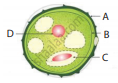
How many middle layers are generally present in the wall of the anther lobes?
Length of pollen tube depends on the distance between ______
Which out of the following processes does not lead to the formation of clones.
Which among the following statements are true for unisexual flowers?
- They possess both stamen and pistil
- They possess either stamen or pistil
- They exhibit cross pollination
- Unisexual flowers possessing only stamens cannot produce fruits
Sketch and label the essential and accessory whorls of flower.
Sexual maturation of reproductive tissues and organs are necessary link for reproduction. Elucidate.
Explain the post fertilization changes that occur in the ovary of a flower.
State the post-fertilisation changes that lead to fruit formation in plants.
