Advertisements
Advertisements
Questions
Mention pollination types.
Explain the different types of pollination.
Advertisements
Solution
- Self-pollination: It is the transfer of pollen grains from the anther to the stigma of the same flower or another flower on the same plant.
- Cross-pollination: It is the transfer of pollen grains from the anther to the stigma of the flower present on two different plants.
APPEARS IN
RELATED QUESTIONS
Name the parts labelled as A, B, C and D in the diagram given below:-

How does fertilisation occur in flowers? Name the parts of the flower that develop into (i) seed, and (ii) fruit after fertilisation.
State significance of pollination.
Write the names of those parts of a flower which serve the same function as the following do in the animals :
(i) testis,
(ii) sperm,
(iii) ovary,
(iv) egg
How is the process of pollination different from fertilization?
The fusion of male and female gametes is termed as ______.
What is the name of female part of a flower?
Fill in the following blank with suitable word :
Ovules contain ......... gametes of a plant.
Fill in the following blank with suitable word :
Flowering plants reproduce by ...........method of reproduction.
What is made in ovary of a flower?
What is meant by ‘unisexual flowers’?
Describe the process of fertilisation in a flower with the help of labelled diagrams.
Multiple choice question. Tick (✓) the correct choice:
Unisexual flowers are found in
- mulberry
- mustard
- pea
- sunflower
Mention the function of Flower.
What are the male and female gametes in a flowering plant?
Draw a labelled diagram of a bisexual flower.
Write one main difference between asexual and sexual mode of reproduction. Which species is likely to have comparatively better chances of survival – the one reproducing asexually or the one reproducing sexually? Give reason to justify your answer.
Identify A, B, C and D in the given diagram and write their names.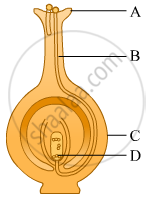
A student is asked to study the different parts of an embryo of pea seeds. Given below are the essential steps for the experiment :
(I) Soak the pea seeds in plain water and keep them overnight.
(II) Cut open the soaked seed and observe its different parts.
(III) Take some pea seeds in a petri dish.
(IV) Drain the excess water. Cover the seeds with a wet cotton cloth and leave them as it is for a day.
The correct sequence of these steps is
(A) III, I, IV, II
(B) III, IV, I, II
(C) III, I, II, IV
(D) III, II, I, IV
“Cell division is a type of reproduction in unicellular organism.” Justify.
List any two differences between pollination and fertilization.
Answer the following question.
How does suitable pollination lead to fertilization?
A student is observing the temporary mount of a leaf peel under a microscope. Draw a labelled diagram of the structure of stomata as seen under the microscope
Find the odd one out:
Give scientific reason.
Flower is a structural unit of sexual reproduction in plants.
Identify the parts A, B, C, and D?
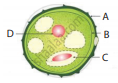
Which of the following is the outermost protective layer of anther?
Gloriosa superba exhibits ______.
Sperm and egg nuclei fuse due to ______.
Conidia are formed endogenously while zoospores are formed endogenously.
The process of release of eggs from the ovary is called ______
Is the chromosome number of zygote, embryonal cells and adult of a particular organism always constant? How is the constancy maintained in these three stages?
Where is the zygote located in the flower after fertilization?
What is the structural unit of sexual reproduction in plant?
State the post-fertilisation changes that lead to fruit formation in plants.
- Assertion: Primary endosperm nucleus is diploid.
- Reason: It is the product of double fertilisation.
