Advertisements
Advertisements
प्रश्न
Which of the following is not an unisexual flower?
a) Coconut
b) Papaya
c) Gulmohor
d) Maize
Advertisements
उत्तर
c) Gulmohor
APPEARS IN
संबंधित प्रश्न
Match the following:
| Column A | Column B |
| (i) Stigma | (a) Neuron |
| (ii) Pepsin | (b) Carpel |
| (iii) Dendrites | (c) Protein |
| (d) Stamen |
A student identified the various parts of an embryo of a gram seed and listed them as given below :
(I) Testa
(II) Plumule
(III) Radicle
(IV) Cotyledon
(V) Tegmen
Out of these the actual parts of the embryo are :
(A) I, II, III
(B) II, III, IV
(C) III, IV, V
(D) II, IV, V
Name the parts labelled as A, B, C and D in the diagram given below:

Name the male part of the flower.
Where are the pollen grains produced?
Where is the male gamete formed in flowering plants?
Where is the female gamete formed in flowering plants?
Fill in the following blank with suitable word :
Pollen grains contain ............ gametes of a plant.
Fill in the following blank with suitable word :
The female organ of reproduction in the flower is the...........
Fill in the following blank with suitable word :
The male organ of reproduction in the flower is the.......... .
How do the insects help in cross-pollination?
Give some examples of different modes of fertilisation in nature?
Name the part of a seed which grows into root.
What changes take place in the flower after fertilisation which lead to the formation of seeds and fruit?
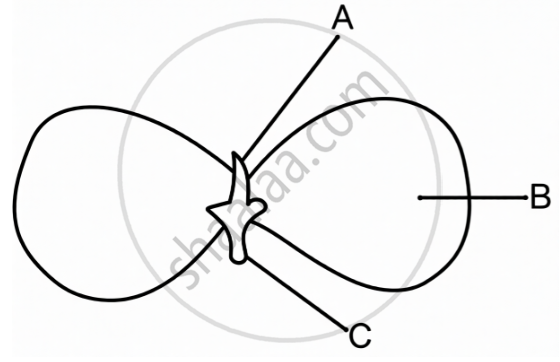
In the figure given alongside, the parts marked A, B and C are sequentially:
The part of a seed which grows and develops into root on germination is :
(a) cotyledon
(b) plumule
(c) follicle
(d) radicle
In a bisexual flower, inspite of the young stamens being removed artificially, the flower produces fruit. Explain.
Fill in the blank by selecting suitable word:
A flower bearing only male or female parts is known as __________ flower.
Multiple choice question. Tick (✓) the correct choice:
Unisexual flowers are found in
- mulberry
- mustard
- pea
- sunflower
State whether the following statement is true (T) or false (F):
Stamens make egg cells.
Mention the function of Flower.
Write one main difference between asexual and sexual mode of reproduction. Which species is likely to have comparatively better chances of survival – the one reproducing asexually or the one reproducing sexually? Give reason to justify your answer.
You have to perform the experiment, "To identify the different parts of an embryo of a gram seed." Describe the procedure that you would follow.
Draw a diagram of the longitudinal section of a flower exhibiting germination of pollen on stigma and label (i) ovary, (ii) male germ-cell, (iii) female germ-cell and (iv) ovule on it.
Mention pollination types.
Answer the following question.
How does suitable pollination lead to fertilization?
What is cleistogamy? Write one advantage and one disadvantage of it, to the plant.
Define.
Inflorescence
What does germination mean?
Write the events involved in the sexual reproduction of a flowering plant.
a. Discuss the first event and write the types.
b. Mention the advantages and the disadvantages of that event.
Identify the female gametophyte in angiosperms.
What would be the number of chromosomes of the aleurone cells of a plant with 42 chromosomes in its roots tip cells?
Complete the table
| Carly x | ______ | ______ |
| ______ | petal | attract insects |
| Androecium | ______ | Male reproductive part |
| ______ | ______ | Female reproductive part. |
Which among the following statements are true for unisexual flowers?
- They possess both stamen and pistil
- They possess either stamen or pistil
- They exhibit cross pollination
- Unisexual flowers possessing only stamens cannot produce fruits
Trace the path a male gamete takes to fertilise a female gamete after being released from the penis.
What is the function of calyx?
The figure below shows the concept of double fertilization. Complete the flow chart showing the progress at each step:

In flowering plants, the pollen grains are transferred to stigma by pollination but the female germ cells are present in the ovary.
Explain with the help of a labelled diagram (only concerned parts), how the male germ cell reaches the ovary.
The pollen tube usually enters the embryo sac ______.
