Advertisements
Advertisements
प्रश्न
Draw a diagram of the longitudinal section of a flower and label the following parts.
Draw a labelled diagram of the longitudinal section of a flower.
Draw a well-labelled diagram of the longitudinal section of a flower.
Advertisements
उत्तर १
Longitudinal section of a flower:
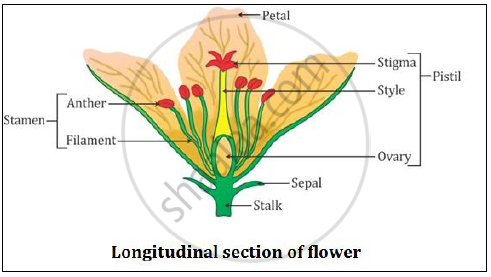
उत्तर २

Longitudinal section of flower
संबंधित प्रश्न
A student was asked to observe and identify the various parts of an embryo of a red kidney bean seed. He identified the parts and listed them as under:
I. Tegmen
II. Testa
III. Cotyledon
IV. Radicle
V. Plumule
The correctly identified parts among these are
(A) I, II and III
(B) II, III and IV
(C) III, IV and V
(D) I, III, IV and V
Name the parts A, B and C shown in the diagram and write their functions.

In the following diagram showing the structure of embryo of a dicot seed, what are the parts marked I, II and III sequentially?

A student while observing an embryo of a pea seed in the laboratory listed various parts of the embryo as given below:
Testa, Tegmen, Radicle, Plumule, Micropyle, Cotyledon.
On examining the list the teacher remarked that only three parts are correct. Select three correct parts from the above list:
(a) Testa, Radicle, Cotyleddon
(b) Tegmen, Radicle, Micropyle
(c) Cotyledon, Plumule, Testa
(d) Radicle, Cotyledon, Plumule
"The chromosomal number of the sexually producing parents and their offspring is the same." Justify this statement.
How is the process of pollination different from fertilization?
How does the process of fertilisation take place in flowers?
The reproductive part of a plant is the ______.
The process of fusion of the male and female gametes is called ______.
Fill in the following blank with suitable word :
The ovule becomes a .......... after fertilisation.
What type of plants reproduce by sexual reproduction method?
What is meant by ‘unisexual flowers’?
Draw a neat diagram of a flower showing its various parts. In this diagram mark stem, receptacle, sepals, petals, stamen and carpel.
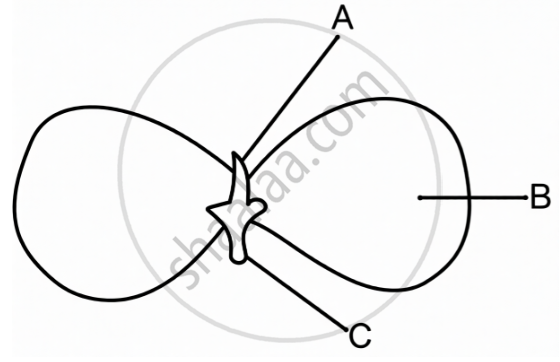
In the figure given alongside, the parts marked A, B and C are sequentially:
In a bisexual flower, inspite of the young stamens being removed artificially, the flower produces fruit. Explain.
Fill in the blank by selecting suitable word:
A flower bearing only male or female parts is known as __________ flower.
Fill in the blanks:
A carpel consists of ________ , ________ and ________.
State whether the following statement is true (T) or false (F):
Stamens make egg cells.
Find the odd-one out, giving reason:
Anther, pollen grain, ovule male gamete
Give one example each of unisexual and bisexual flowers. Differentiate between the two types of pollination that occur in flowers. What happens when a pollen lands on a suitable stigma? Write about the events that occur till the seed formation in the ovary.
Distinguish between unisexual and bisexual flowers giving one example of each. Draw a diagram showing process of germination of pollen grains on stigma and label the following parts:
(a) Female germ cell
(b) Male germ cell
(c) Ovary
Draw a diagram of the longitudinal section of a flower and label on it sepal, petal, ovary and stigma.
Explain sexual reproduction in plants.
Fill in the blank by selecting suitable word:
Transfer of pollen grains from the anther to the stigma is known as______________.
Find an odd one out.
Accessory whorls : Calyx and corolla : : essential whorls : ______________
Match the following
| 1. | Petal | Opuntia |
| 2. | Fern | Chrysanthemum |
| 3. | Phylloclade | Attracts insect |
| 4. | Hooks | Spore |
| 5. | Sucker | Bignonia |
Write the events involved in the sexual reproduction of a flowering plant.
Discuss the first event and write the types.
How many middle layers are generally present in the wall of the anther lobes?
The 3-celled egg apparatus at the micropylar end comprises of ______
Identify the female gametophyte in angiosperms.
Flowers showing ornithophily show few characteristic like ______.
Variations occur as a result of ______
Where is the zygote located in the flower after fertilization?
Double fertilization is exhibited by ______
Double fertilization is essential for formation of ______.
Name the reproductive parts of an angiosperm. Where are these parts located? Explain the structure of its male reproductive part.
