Advertisements
Advertisements
प्रश्न
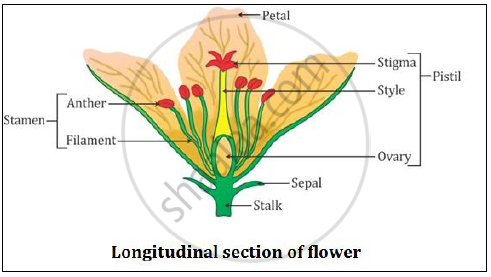
Draw a diagram of the longitudinal section of a flower and label the following parts.
Draw a labelled diagram of the longitudinal section of a flower.
Draw a well-labelled diagram of the longitudinal section of a flower.
Advertisements
उत्तर १
Longitudinal section of a flower:
उत्तर २

Longitudinal section of flower
संबंधित प्रश्न
Name the parts labelled as A, B, C and D in the diagram given below:-

In the following diagram showing the structure of embryo of a dicot seed, what are the parts marked I, II and III sequentially?

Write the names of those parts of a flower which serve the same function as the following do in the animals :
(i) testis,
(ii) sperm,
(iii) ovary,
(iv) egg
The anther contains ______.
How does the process of fertilisation take place in flowers?
Name the male part of the flower.
What is the name of female part of a flower?
Fill in the following blank with suitable word :
Pollen grains contain ............ gametes of a plant.
Fill in the following blank with suitable word :
The female organ of reproduction in the flower is the...........
Fill in the following blank with suitable word :
The name of the structure in the flower in which the male gamete is formed is...........
Draw a neat sketch of the carpel of a flower. Mark in it stigma, style and ovary.
How do the insects help in cross-pollination?
Name the part of a seed which grows into root.
Name the part of a seed which grows into shoot.
One of the following occurs in the reproductive system of flowering plants as well as that of humans. This is :
(a) vas deferens
(b) anther
(c) ovary
(d) style
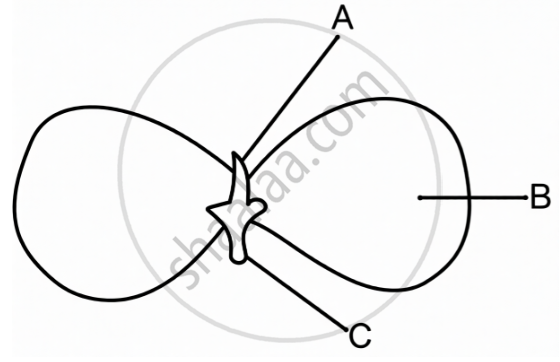
In the figure given alongside, the parts marked A, B and C are sequentially:
In what ways is fertilisation in a plant similar to fertilisation in a human?
Fill in the blanks:
A carpel consists of ________ , ________ and ________.
State whether the following statement is true (T) or false (F):
Stamens make egg cells.
Draw a labelled diagram of a bisexual flower.
Give one example each of unisexual and bisexual flowers. Differentiate between the two types of pollination that occur in flowers. What happens when a pollen lands on a suitable stigma? Write about the events that occur till the seed formation in the ovary.
Identify A, B, C and D in the given diagram and write their names.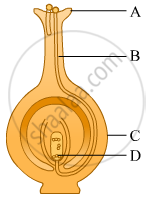
Describe an activity to demonstrate phototropism.
Prepare a slogan for campaign against female foeticide.
Fill in the blanks and rewrite the completed statements:
Lymph flows in _______________ direction.
A student is observing the temporary mount of a leaf peel under a microscope. Draw a labelled diagram of the structure of stomata as seen under the microscope
Distinguish between self-pollination and cross-pollination.
Explain the sexual reproduction process in plants with a diagram.
Match the following
| 1. | Petal | Opuntia |
| 2. | Fern | Chrysanthemum |
| 3. | Phylloclade | Attracts insect |
| 4. | Hooks | Spore |
| 5. | Sucker | Bignonia |
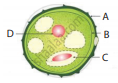
Identify the parts A, B, C, and D?
Write the events involved in the sexual reproduction of a flowering plant.
Discuss the first event and write the types.
The anther wall consists of four wall layers where ______
In which of the following manner the arrangement of megaspores in a tetrad is observed in angiosperms?
The ovule of an angiosperm is technically equivalent to ______
Which type of development is observed in male gametophytes of plants?
In a flowering plant, archesporium gives rise to ______.
The seed that contains the future plant is called the ______
Where is the zygote located in the flower after fertilization?
Triple fusion involves ______.
State the post-fertilisation changes that lead to fruit formation in plants.
