Advertisements
Advertisements
प्रश्न
What is the function of calyx?
Advertisements
उत्तर
The main function of calyx is to protect the inner whorls of the flower.
APPEARS IN
संबंधित प्रश्न
How does fertilisation occur in flowers? Name the parts of the flower that develop into (i) seed, and (ii) fruit after fertilisation.

(i) Name the part marked 'A' in the diagram.
(ii) How dose 'A' reachese part 'B'?
(iii) State the importance of the part 'C'.
(iv) What happens to the part marked 'D' after fertilisation is over?
A student has to perform the experiment "To identify the different parts of an embryo of a dicot seed." Select from the following an appropriate group of seeds:
(a) Pea, gram, wheat
(b) Red kidney bean, maize, gram
(c) Maize, wheat, red kidney bean
(d) Red kidney bean, pea, gram
State significance of pollination.
The anther contains ______.
A flower may have either male or female reproductive parts. Such a flower is called ______.
The fusion of male and female gametes is termed as ______.
The reproductive part of a plant is the ______.
The process of fusion of the male and female gametes is called ______.
Name the male part of the flower.
Fill in the following blank with suitable word :
The ovule becomes a .......... after fertilisation.
Fill in the following blank with suitable word :
The.......... at the base of the carpel contains egg cells.
Fill in the following blank with suitable word :
The term used to refer to the transfer of pollen from the stamen of one flower to the carpel of another flower of the same species is...........
Describe the process of fertilisation in a flower with the help of labelled diagrams.
One of the following occurs in the reproductive system of flowering plants as well as that of humans. This is :
(a) vas deferens
(b) anther
(c) ovary
(d) style
The part of a seed which grows and develops into root on germination is :
(a) cotyledon
(b) plumule
(c) follicle
(d) radicle
Fill in the blank by selecting suitable word:
A flower that bears both the male and the female parts is known as __________ flower.
Fill in the blanks:
A carpel consists of ________ , ________ and ________.
What part is played by stamens and carpels in reproduction?
Identify A, B, C and D in the given diagram and write their names.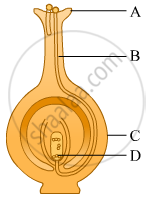
A student is asked to study the different parts of an embryo of pea seeds. Given below are the essential steps for the experiment :
(I) Soak the pea seeds in plain water and keep them overnight.
(II) Cut open the soaked seed and observe its different parts.
(III) Take some pea seeds in a petri dish.
(IV) Drain the excess water. Cover the seeds with a wet cotton cloth and leave them as it is for a day.
The correct sequence of these steps is
(A) III, I, IV, II
(B) III, IV, I, II
(C) III, I, II, IV
(D) III, II, I, IV
In the figure, the parts marked A, B and C are sequentially:

(A) Plumule, Radicle and Cotyledon
(B) Radicle, Plumule and Cotyledon
(C) Plumule, Cotyledon and Radicle
(D) Radicle, Cotyledon and Plumule
Identify the odd. Stigma, Style, Pollen, Ovary.
Fill in the blanks and rewrite the completed statements:
Lymph flows in _______________ direction.
Find the odd one out:
Pollen grains are formed by _________ division in locules of anthers.
Pollen tube reaches the embryo sac via style.
The essential parts of a flower are ______.
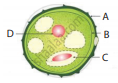
Identify the parts A, B, C, and D?
Which of the following are the chemical components of the wall of pollen tube?
The flower of the Hibiscus plant is ______
In human beings, fertilization occurs in the ______
Length of pollen tube depends on the distance between ______
Draw the diagram of a flower and label the four whorls. Write the names of gamete producing organs in the flower.
Trace the path a male gamete takes to fertilise a female gamete after being released from the penis.
State the number of sets of chromosomes present in a zygote.
Double fertilization is essential for formation of ______.
