Advertisements
Advertisements
प्रश्न
What is the function of calyx?
Advertisements
उत्तर
The main function of calyx is to protect the inner whorls of the flower.
APPEARS IN
संबंधित प्रश्न
Name the parts A, B and C shown in the diagram and write their functions.


(i) Name the part marked 'A' in the diagram.
(ii) How dose 'A' reachese part 'B'?
(iii) State the importance of the part 'C'.
(iv) What happens to the part marked 'D' after fertilisation is over?
"The chromosomal number of the sexually producing parents and their offspring is the same." Justify this statement.
What is the name of female part of a flower?
Fill in the following blank with suitable word :
The male organ of reproduction in the flower is the.......... .
Fill in the following blank with suitable word :
The name of the structure in the flower in which the male gamete is formed is...........
What changes take place in the flower after fertilisation which lead to the formation of seeds and fruit?
One of the following occurs in the reproductive system of flowering plants as well as that of humans. This is :
(a) vas deferens
(b) anther
(c) ovary
(d) style
In the figure given alongside, the parts marked A, B and C are sequentially:
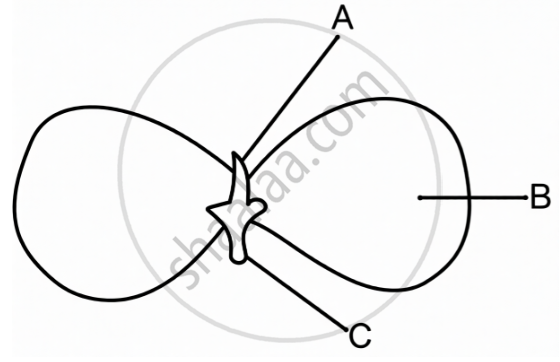
In what ways is fertilisation in a plant similar to fertilisation in a human?
Put a tick mark (✓) against the correct alternative in the following statement
Reproductive whorls of a flower are:
Fill in the blank by selecting suitable word:
A flower that bears both the male and the female parts is known as __________ flower.
What are the male and female gametes in a flowering plant?
Write one main difference between asexual and sexual mode of reproduction. Which species is likely to have comparatively better chances of survival – the one reproducing asexually or the one reproducing sexually? Give reason to justify your answer.
Explain the process of fertilisation in flowers.
A student is asked to study the different parts of an embryo of pea seeds. Given below are the essential steps for the experiment :
(I) Soak the pea seeds in plain water and keep them overnight.
(II) Cut open the soaked seed and observe its different parts.
(III) Take some pea seeds in a petri dish.
(IV) Drain the excess water. Cover the seeds with a wet cotton cloth and leave them as it is for a day.
The correct sequence of these steps is
(A) III, I, IV, II
(B) III, IV, I, II
(C) III, I, II, IV
(D) III, II, I, IV
“Cell division is a type of reproduction in unicellular organism.” Justify.
Describe an activity to demonstrate phototropism.
Explain sexual reproduction in plants.
Prepare a slogan for campaign against female foeticide.
Fill in the blank by selecting suitable word:
Transfer of pollen grains from the anther to the stigma is known as______________.
Answer the following question.
How does suitable pollination lead to fertilization?
Find an odd one out.
Explain the sexual reproduction process in plants with a diagram.
The male reproductive part of a flower is ______.
Match the following
| 1. | Petal | Opuntia |
| 2. | Fern | Chrysanthemum |
| 3. | Phylloclade | Attracts insect |
| 4. | Hooks | Spore |
| 5. | Sucker | Bignonia |
The anther wall consists of four wall layers where ______
Generally, in a pollen tube, which of the following moves to the tip of the tube?
The 3-celled egg apparatus at the micropylar end comprises of ______
Pollen grains are produced by ______
Which out of the following processes does not lead to the formation of clones.
Draw the diagram of a flower and label the four whorls. Write the names of gamete producing organs in the flower.
What is the structural unit of sexual reproduction in plant?
The figure below shows the concept of double fertilization. Complete the flow chart showing the progress at each step:

Name the reproductive parts of an angiosperm. Where are these parts located? Explain the structure of its male reproductive part.
The pollen tube usually enters the embryo sac ______.
State the post-fertilisation changes that lead to fruit formation in plants.
