Advertisements
Advertisements
प्रश्न
| When an insect sits on the flower of a plant then somene particles A present in the top of little stalks in the flower attach to its body hair. When this insect now sits on the flower of another similar plant, then particles A attached to the hair of insect are put on the top of a flask-shaped organ at the centre of flower. The particle A grows a long tube B from the top of flask-shaped organ through which C moves down and reaches the bottom part of flask-shaped organ. Here C fuses with the nucleus of D contained in structure E. The fusion of C and D forms a new cell F which grows and develops into a seed of the plant. |
- What are particles A? What is the process of transferring A from one flower to another flower of similar plant by the insect known as?
- What is the name of tube B?
- What is C which moves down through the tube B?
- Name D and E.
- What is F?
Advertisements
उत्तर
- A: Pollen grains. The process of transferring pollen grains from one flower to another flower of the same species by an insect is called cross-pollination.
- B: Pollen tube
- C: Male gamete (male nucleus)
- D: Egg cell (female gamete) and E: Ovule
- F: Zygote
APPEARS IN
संबंधित प्रश्न
How does fertilisation occur in flowers? Name the parts of the flower that develop into (i) seed, and (ii) fruit after fertilisation.
How is the process of pollination different from fertilization?
What is the function of a flower?
Explain the terms 'self pollination'
What is seed?
Draw a neat diagram of a flower showing its various parts. In this diagram mark stem, receptacle, sepals, petals, stamen and carpel.
Which of the following statements are true for flowers?
(i) Flowers are always bisexual.
(ii) They contain sexual reproductive organs.
(iii) They are produced in all groups of plants.
(iv) after fertilization they give rise to fruits.
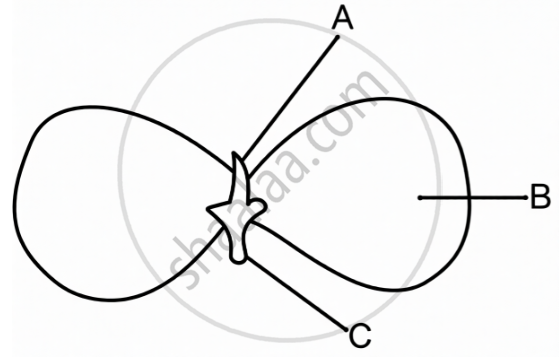
In the figure given alongside, the parts marked A, B and C are sequentially:
Multiple choice question. Tick (✓) the correct choice:
Unisexual flowers are found in
- mulberry
- mustard
- pea
- sunflower
Mention the function of Stigma.
What are the male and female gametes in a flowering plant?
A student is asked to study the different parts of an embryo of pea seeds. Given below are the essential steps for the experiment :
(I) Soak the pea seeds in plain water and keep them overnight.
(II) Cut open the soaked seed and observe its different parts.
(III) Take some pea seeds in a petri dish.
(IV) Drain the excess water. Cover the seeds with a wet cotton cloth and leave them as it is for a day.
The correct sequence of these steps is
(A) III, I, IV, II
(B) III, IV, I, II
(C) III, I, II, IV
(D) III, II, I, IV
Prepare a slogan for campaign against female foeticide.
Pollen grains from anther are transferred to the stigma.
The ovule of an angiosperm is technically equivalent to ______
Which of the following is the outermost protective layer of anther?
Gloriosa superba exhibits ______.
Pineapple fruit develops from ______.
Which among the following statements are true for sexual reproduction in flowering plants?
- It requires two types of gametes
- Fertilisation is a compulsory event
- It always results in formation of zygote
- Offspring formed are clones
The number of pollen sacs in a dithecous anther is ______.
