Advertisements
Advertisements
प्रश्न
Sketch the labelled diagram.
Flower with its sexual reproductive organs.
Advertisements
उत्तर
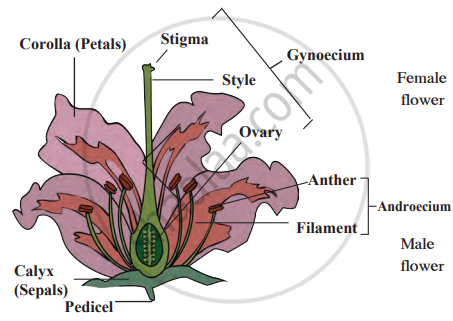
APPEARS IN
संबंधित प्रश्न
In the following diagram showing the structure of embryo of a dicot seed, what are the parts marked I, II and III sequentially?

Name the parts A, B and C shown in the following diagram and state one function of each.

"The chromosomal number of the sexually producing parents and their offspring is the same." Justify this statement.
Write the names of those parts of a flower which serve the same function as the following do in the animals :
(i) testis,
(ii) sperm,
(iii) ovary,
(iv) egg
A flower may have either male or female reproductive parts. Such a flower is called ______.
The process of fusion of the male and female gametes is called ______.
State the name of the functional unit concerned with sexual reproduction.
Name the male part of the flower.
What is the function of a flower?
Fill in the following blank with suitable word :
The name of the structure in the flower in which the male gamete is formed is...........
Fill in the following blank with suitable word :
The term used to refer to the transfer of pollen from the stamen of one flower to the carpel of another flower of the same species is...........
Name the part of a seed which grows into root.
How does pollination occur?
What changes take place in the flower after fertilisation which lead to the formation of seeds and fruit?
In a bisexual flower, inspite of the young stamens being removed artificially, the flower produces fruit. Explain.
Put a tick mark (✓) against the correct alternative in the following statement
Pollen is produced in the:
Put a tick mark (✓) against the correct alternative in the following statement
Reproductive whorls of a flower are:
Multiple choice question. Tick (✓) the correct choice:
Unisexual flowers are found in
- mulberry
- mustard
- pea
- sunflower
Explain the process of fertilisation in flowers.
Distinguish between unisexual and bisexual flowers giving one example of each. Draw a diagram showing process of germination of pollen grains on stigma and label the following parts:
(a) Female germ cell
(b) Male germ cell
(c) Ovary
List any two differences between pollination and fertilization.
Prepare a slogan for campaign against female foeticide.
A student is observing the temporary mount of a leaf peel under a microscope. Draw a labelled diagram of the structure of stomata as seen under the microscope
What is cleistogamy? Write one advantage and one disadvantage of it, to the plant.
Answer the following question.
List two agents of pollination?
Accessory whorls : Calyx and corolla : : essential whorls : ______________
Define.
Inflorescence
Give scientific reason.
Fertilization in plants is called double fertilization.
In which part of the flower germination of pollen grains takes place?
In which of the following manner the arrangement of megaspores in a tetrad is observed in angiosperms?
Which of the following is the outermost protective layer of anther?
Which type of development is observed in male gametophytes of plants?
Identify the female gametophyte in angiosperms.
Conidia are formed endogenously while zoospores are formed endogenously.
The flower of the Hibiscus plant is ______
The ovaries of different flowers may contain ______.
Consider the following three flowers namely X, Y and Z. Which flower(s) would develop into a fruit?
| Flower X | Flower Y | Flower Z |
 |
 |
 |
Explain the post fertilization changes that occur in the ovary of a flower.
- Assertion: Primary endosperm nucleus is diploid.
- Reason: It is the product of double fertilisation.
