Advertisements
Advertisements
प्रश्न
In tobacco plant, the male gametes have 24 chromosomes.
What is the number of chromosomes in the zygote?
Advertisements
उत्तर
The zygote is formed by the fusion of a male and a female gamete. Therefore, the number of chromosomes in a zygote is twice as many as that of a gamete, i.e., 48.
APPEARS IN
संबंधित प्रश्न
Name the parts labelled as A, B, C and D in the diagram given below:-


(i) Name the part marked 'A' in the diagram.
(ii) How dose 'A' reachese part 'B'?
(iii) State the importance of the part 'C'.
(iv) What happens to the part marked 'D' after fertilisation is over?
Write the names of those parts of a flower which serve the same function as the following do in the animals :
(i) testis,
(ii) sperm,
(iii) ovary,
(iv) egg
The anther contains ______.
Name the part of a seed which contains stored food.
What changes take place in the flower after fertilisation which lead to the formation of seeds and fruit?
Draw a neat diagram of a flower showing its various parts. In this diagram mark stem, receptacle, sepals, petals, stamen and carpel.
Which of the following statements are true for sexual reproduction in flowering plants?
(i) it requires two types of gametes
(ii) fertilisation is a compulsory event
(iii) it always results in the formation of zygote
(iv) offsprings formed are clones
(a) (i) and (iv)
(b) (i), (ii) and (iv)
(c) (i), (ii) and (iii)
(d) (ii), (iii) and (iv)
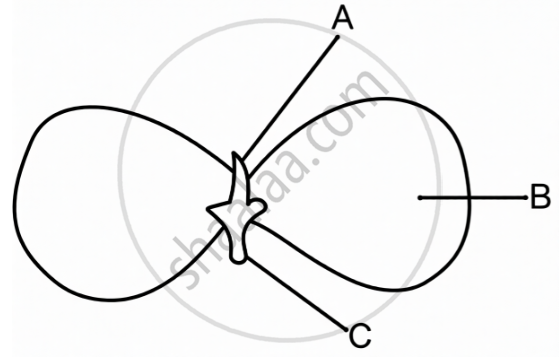
In the figure given alongside, the parts marked A, B and C are sequentially:
Find the odd-one out, giving reason:
Anther, pollen grain, ovule male gamete
The students of a class were asked by the teacher to study the different parts of an embryo of an angiosperm. Given below are the essential steps for the experiment :
A. Soak the seeds in plain water and keep them overnight.
B. Cut open the soaked seed and observe its different parts.
C. Take some healthy seeds in a petri-dish.
D. Drain the excess water, cover the seeds with a wet cotton cloth and leave them as it is for a day.
The correct sequence of these steps is
(a) C, A, D, B
(b) C, D, A, B
(c) A, C, D, B
(d) A, C, B, D
Draw a diagram of the longitudinal section of a flower exhibiting germination of pollen on stigma and label (i) ovary, (ii) male germ-cell, (iii) female germ-cell and (iv) ovule on it.
Answer the following question.
How does suitable pollination lead to fertilization?
Which type of development is observed in male gametophytes of plants?
What would be the number of chromosomes of the aleurone cells of a plant with 42 chromosomes in its roots tip cells?
Which among the following statements are true for sexual reproduction in flowering plants?
- It requires two types of gametes
- Fertilisation is a compulsory event
- It always results in formation of zygote
- Offspring formed are clones
The ovaries of different flowers may contain ______.
In a plant flower the female whorl is ______.
In flowering plants, the pollen grains are transferred to stigma by pollination but the female germ cells are present in the ovary.
Explain with the help of a labelled diagram (only concerned parts), how the male germ cell reaches the ovary.
State the post-fertilisation changes that lead to fruit formation in plants.
