Advertisements
Advertisements
Question
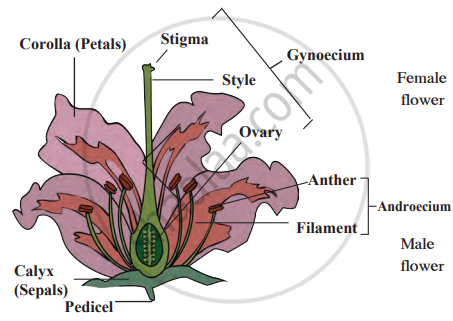
Sketch the labelled diagram.
Flower with its sexual reproductive organs.
Advertisements
Solution
APPEARS IN
RELATED QUESTIONS
Match the following:
| Column A | Column B |
| (i) Stigma | (a) Neuron |
| (ii) Pepsin | (b) Carpel |
| (iii) Dendrites | (c) Protein |
| (d) Stamen |
A student was asked to observe and identify the various parts of an embryo of a red kidney bean seed. He identified the parts and listed them as under:
I. Tegmen
II. Testa
III. Cotyledon
IV. Radicle
V. Plumule
The correctly identified parts among these are
(A) I, II and III
(B) II, III and IV
(C) III, IV and V
(D) I, III, IV and V
Name the parts A, B and C shown in the following diagram and state one function of each.

A student identified the various parts of an embryo of a gram seed and listed them as given below :
(I) Testa
(II) Plumule
(III) Radicle
(IV) Cotyledon
(V) Tegmen
Out of these the actual parts of the embryo are :
(A) I, II, III
(B) II, III, IV
(C) III, IV, V
(D) II, IV, V
The reproductive part of a plant is the ______.
Name the part made up of the stigma, style and ovary.
Name the male part of the flower.
Fill in the following blank with suitable word :
Pollen grains contain ............ gametes of a plant.
Fill in the following blank with suitable word :
The female organ of reproduction in the flower is the...........
What is made in anther of a flower?
Explain the term 'fertilisation'.
What is seed?
What changes take place in the flower after fertilisation which lead to the formation of seeds and fruit?
The length of pollen tube depends on the distance between :
(a) pollen grain and upper surface of stigma
(b) pollen grain on upper surface of stigma and ovule
(c) pollen grain in anther and upper surface of stigma
(d) upper surface of stigma and lower part of style
One of the following occurs in the reproductive system of flowering plants as well as that of humans. This is :
(a) vas deferens
(b) anther
(c) ovary
(d) style
The correct sequence of reproductive stages occurring in flowering plants is ______.
Mention the function of Stigma.
Draw a labelled diagram of a bisexual flower.
Explain the process of fertilisation in flowers.
Draw a diagram of the longitudinal section of a flower and label on it sepal, petal, ovary and stigma.
Which of the following is not an unisexual flower?
a) Coconut
b) Papaya
c) Gulmohor
d) Maize
What is meant by pollination?
Pollen grains from anther are transferred to the stigma.
What does germination mean?
Distinguish between self-pollination and cross-pollination.
The male reproductive part of a flower is ______.
The essential parts of a flower are ______.
The anther wall consists of four wall layers where ______
What would be the number of chromosomes in the cells of the aleurone layer in a plant species with 8 chromosomes in its synergids?
In human beings, fertilization occurs in the ______
Length of pollen tube depends on the distance between ______
The ovaries of different flowers may contain ______.
Double fertilization means ______.
What is the structural unit of sexual reproduction in plant?
What is the function of calyx?
Name the reproductive parts of an angiosperm. Where are these parts located? Explain the structure of its male reproductive part.
Consider the following three flowers namely X, Y and Z. Which flower(s) would develop into a fruit?
| Flower X | Flower Y | Flower Z |
 |
 |
 |
Explain the post fertilization changes that occur in the ovary of a flower.
