Advertisements
Advertisements
प्रश्न
Sketch the labelled diagram.
Flower with its sexual reproductive organs.
Advertisements
उत्तर
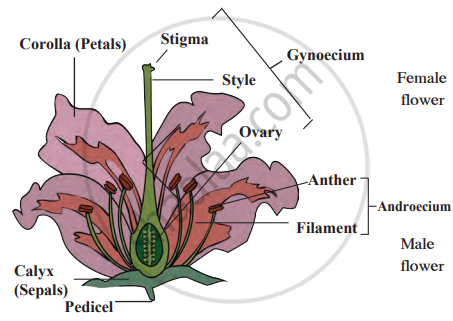
APPEARS IN
संबंधित प्रश्न
Mention the changes a flower undergoes after fertilisation.
Explain what you understand by sexual reproduction.
Name the part made up of the stigma, style and ovary.
Fill in the following blank with suitable word :
Pollen grains contain ............ gametes of a plant.
Fill in the following blank with suitable word :
Ovules contain ......... gametes of a plant.
Draw a neat sketch of the carpel of a flower. Mark in it stigma, style and ovary.
What is made in anther of a flower?
Explain the term 'fertilisation'.
What is seed?
In tobacco plant, the male gametes have 24 chromosomes.
What is the number of chromosomes in the zygote?
What is meant by ‘unisexual flowers’?
Draw a neat diagram of a flower showing its various parts. In this diagram mark stem, receptacle, sepals, petals, stamen and carpel.
Which of the following is the correct sequence of events of sexual reproduction in a flower?
(a) pollination, fertilisation, seed, embryo
(b) seed, embryo, fertilisation, pollination
(c) pollination, fertilisation, embryo, seed
(d) embryo, seed, pollination, fertilisation
In what ways is fertilisation in a plant similar to fertilisation in a human?
Put a tick mark (✓) against the correct alternative in the following statement
Reproductive whorls of a flower are:
Fill in the blank by selecting suitable word:
A flower that bears both the male and the female parts is known as __________ flower.
Fill in the blanks:
A stamen consists of ______ and ________.
Mention the function of Stigma.
Draw a labelled diagram of a bisexual flower.
You have to perform the experiment, "To identify the different parts of an embryo of a gram seed." Describe the procedure that you would follow.
Draw a diagram of the longitudinal section of a flower exhibiting germination of pollen on stigma and label (i) ovary, (ii) male germ-cell, (iii) female germ-cell and (iv) ovule on it.
Distinguish between unisexual and bisexual flowers giving one example of each. Draw a diagram showing process of germination of pollen grains on stigma and label the following parts:
(a) Female germ cell
(b) Male germ cell
(c) Ovary
Accessory whorls : Calyx and corolla : : essential whorls : ______________
Give scientific reason.
Flower is a structural unit of sexual reproduction in plants.
Give scientific reason.
Fertilization in plants is called double fertilization.
Draw a neat and labelled diagram.
Double fertilization in angiosperms
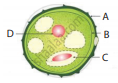
Observe the figure below. Write functions of the labelled parts.

Identify the parts A, B, C, and D?
In which part of the flower germination of pollen grains takes place?
Antipodal cells are present towards the ______ in an anatropous ovule.
Which type of development is observed in male gametophytes of plants?
Sperm and egg nuclei fuse due to ______.
Conidia are formed endogenously while zoospores are formed endogenously.
Which among the following statements are true for sexual reproduction in flowering plants?
- It requires two types of gametes
- Fertilisation is a compulsory event
- It always results in formation of zygote
- Offspring formed are clones
Trace the path a male gamete takes to fertilise a female gamete after being released from the penis.
Double fertilization is exhibited by ______
The figure below shows the concept of double fertilization. Complete the flow chart showing the progress at each step:

Given below is a diagram of a germinating seed. Label the parts that:
- gives rise to future shoot.
- gives rise to future root system.
- stores food.
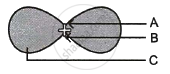
In male reproductive whorl of a flower the archesporial cells are formed by ______.
