Advertisements
Advertisements
प्रश्न
Describe the process of fertilisation in a flower with the help of labelled diagrams.
Advertisements
उत्तर
Fertilisation occurs after pollen grains fall on the stigma. Upon falling on the stigma, the pollen grains burst and grow a pollen tube taht passes downwards from the style to the ovary containing the ovule. The male gamete present in the pollen moves downward through the pollen tube and reaches the ovule. This gamete fuses with the egg to form a zygote. This process is known as fertilisation.

APPEARS IN
संबंधित प्रश्न
A student while observing an embryo of a pea seed in the laboratory listed various parts of the embryo as given below:
Testa, Tegmen, Radicle, Plumule, Micropyle, Cotyledon.
On examining the list the teacher remarked that only three parts are correct. Select three correct parts from the above list:
(a) Testa, Radicle, Cotyleddon
(b) Tegmen, Radicle, Micropyle
(c) Cotyledon, Plumule, Testa
(d) Radicle, Cotyledon, Plumule
Name and differentiate between the two modes of pollination in flowering plants.
Name the male part of the flower.
Fill in the following blank with suitable word :
Pollen grains contain ............ gametes of a plant.
How do the insects help in cross-pollination?
What changes take place in the flower after fertilisation which lead to the formation of seeds and fruit?
Which of the following statements are true for flowers?
(i) Flowers are always bisexual.
(ii) They contain sexual reproductive organs.
(iii) They are produced in all groups of plants.
(iv) after fertilization they give rise to fruits.
Which of the following statements are true for sexual reproduction in flowering plants?
(i) it requires two types of gametes
(ii) fertilisation is a compulsory event
(iii) it always results in the formation of zygote
(iv) offsprings formed are clones
(a) (i) and (iv)
(b) (i), (ii) and (iv)
(c) (i), (ii) and (iii)
(d) (ii), (iii) and (iv)
In what ways is fertilisation in a plant different from fertilisation in a human?
What are the male and female gametes in a flowering plant?
You have to perform the experiment, "To identify the different parts of an embryo of a gram seed." Describe the procedure that you would follow.
Fill in the blanks and rewrite the completed statements:
Lymph flows in _______________ direction.
What is meant by pollination?
Accessory whorls : Calyx and corolla : : essential whorls : ______________
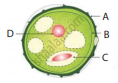
Identify the parts A, B, C, and D?
Which among the following statements are true for sexual reproduction in flowering plants?
- It requires two types of gametes
- Fertilisation is a compulsory event
- It always results in formation of zygote
- Offspring formed are clones
Double fertilization means ______.
The figure below shows the concept of double fertilization. Complete the flow chart showing the progress at each step:

The pollen tube usually enters the embryo sac ______.
Given below is a diagram of a germinating seed. Label the parts that:
- gives rise to future shoot.
- gives rise to future root system.
- stores food.