Advertisements
Advertisements
प्रश्न
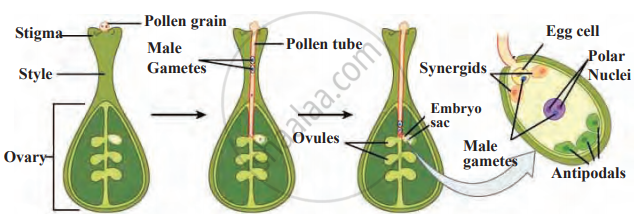
Draw a neat and labelled diagram.
Double fertilization in angiosperms
Advertisements
उत्तर
APPEARS IN
संबंधित प्रश्न
A student was asked to observe and identify the various parts of an embryo of a red kidney bean seed. He identified the parts and listed them as under:
I. Tegmen
II. Testa
III. Cotyledon
IV. Radicle
V. Plumule
The correctly identified parts among these are
(A) I, II and III
(B) II, III and IV
(C) III, IV and V
(D) I, III, IV and V
Name the parts A, B and C shown in the diagram and write their functions.

How does fertilisation occur in flowers? Name the parts of the flower that develop into (i) seed, and (ii) fruit after fertilisation.
Mention the changes a flower undergoes after fertilisation.
The process of fusion of the male and female gametes is called ______.
Mature ovary forms the ______.
Fill in the following blank with suitable word :
Flowering plants reproduce by ...........method of reproduction.
Fill in the following blank with suitable word :
The name of the structure in the flower in which the male gamete is formed is...........
How do the insects help in cross-pollination?
Describe the process of fertilisation in a flower with the help of labelled diagrams.
Which of the following is the correct sequence of events of sexual reproduction in a flower?
(a) pollination, fertilisation, seed, embryo
(b) seed, embryo, fertilisation, pollination
(c) pollination, fertilisation, embryo, seed
(d) embryo, seed, pollination, fertilisation
Put a tick mark (✓) against the correct alternative in the following statement
Reproductive whorls of a flower are:
Find the odd-one out, giving reason:
Anther, pollen grain, ovule male gamete
Draw a labelled diagram of a bisexual flower.
Draw a diagram of the longitudinal section of a flower and label on it sepal, petal, ovary and stigma.
List any two differences between pollination and fertilization.
Which of the following is not an unisexual flower?
a) Coconut
b) Papaya
c) Gulmohor
d) Maize
Fill in the blanks and rewrite the completed statements:
Lymph flows in _______________ direction.
Mention pollination types.
Draw a diagram of the longitudinal section of a flower and label the following parts.
A student is observing the temporary mount of a leaf peel under a microscope. Draw a labelled diagram of the structure of stomata as seen under the microscope
What is meant by pollination?
Find the odd one out:
Calyx : Sepals : : Corolla : ________________
Accessory whorls : Calyx and corolla : : essential whorls : ______________
Generally, in a pollen tube, which of the following moves to the tip of the tube?
Identify the female gametophyte in angiosperms.
What would be the number of chromosomes of the aleurone cells of a plant with 42 chromosomes in its roots tip cells?
Flowers showing ornithophily show few characteristic like ______.
What would be the number of chromosomes in the cells of the aleurone layer in a plant species with 8 chromosomes in its synergids?
The seed that contains the future plant is called the ______
In a bisexual flower inspite of the young stamens being removed artificially, the flower produces fruit. Provide a suitable explanation for the above situation.
Double fertilization is essential for formation of ______.
Triple fusion involves ______.
In flowering plants, the pollen grains are transferred to stigma by pollination but the female germ cells are present in the ovary.
Explain with the help of a labelled diagram (only concerned parts), how the male germ cell reaches the ovary.
The pollen tube usually enters the embryo sac ______.
