Advertisements
Advertisements
Question
Draw a neat and labelled diagram.
Double fertilization in angiosperms
Advertisements
Solution
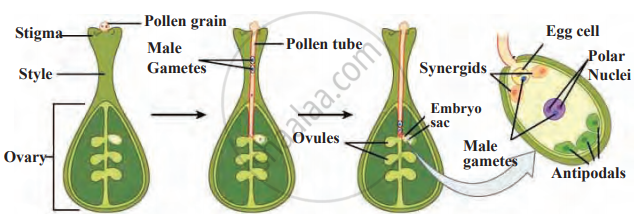
APPEARS IN
RELATED QUESTIONS
Name the parts A, B and C shown in the diagram and write their functions.

Name the parts A, B and C shown in the following diagram and state one function of each.

Mention the changes a flower undergoes after fertilisation.
Write the names of those parts of a flower which serve the same function as the following do in the animals :
(i) testis,
(ii) sperm,
(iii) ovary,
(iv) egg
The fusion of male and female gametes is termed as ______.
Sketch the reproductive parts of a flower.
What is the function of a flower?
Fill in the following blank with suitable word :
The ovary of a flower becomes ....... after fertilisation.
Name the part of a seed which grows into shoot.
In tobacco plant, the male gametes have 24 chromosomes.
What is the number of chromosomes in the zygote?
What is meant by ‘unisexual flowers’?
Draw a neat diagram of a flower showing its various parts. In this diagram mark stem, receptacle, sepals, petals, stamen and carpel.
One of the following occurs in the reproductive system of flowering plants as well as that of humans. This is :
(a) vas deferens
(b) anther
(c) ovary
(d) style
Fill in the blanks:
A stamen consists of ______ and ________.
State whether the following statement is true (T) or false (F):
Stamens make egg cells.
Draw a labelled diagram of a bisexual flower.
Explain the process of fertilisation in flowers.
In the figure, the parts marked A, B and C are sequentially:

(A) Plumule, Radicle and Cotyledon
(B) Radicle, Plumule and Cotyledon
(C) Plumule, Cotyledon and Radicle
(D) Radicle, Cotyledon and Plumule
What is phototropism?
Mention pollination types.
A student is observing the temporary mount of a leaf peel under a microscope. Draw a labelled diagram of the structure of stomata as seen under the microscope
Find an odd one out.
Pollen tube reaches the embryo sac via style.
Distinguish between self-pollination and cross-pollination.
Observe the figure below. Write functions of the labelled parts.

What would be the number of chromosomes of the aleurone cells of a plant with 42 chromosomes in its roots tip cells?
In a flowering plant, archesporium gives rise to ______.
The process of release of eggs from the ovary is called ______
In human beings, fertilization occurs in the ______
Length of pollen tube depends on the distance between ______
Complete the table
| Carly x | ______ | ______ |
| ______ | petal | attract insects |
| Androecium | ______ | Male reproductive part |
| ______ | ______ | Female reproductive part. |
Which among the following statements are true for sexual reproduction in flowering plants?
- It requires two types of gametes
- Fertilisation is a compulsory event
- It always results in formation of zygote
- Offspring formed are clones
Is the chromosome number of zygote, embryonal cells and adult of a particular organism always constant? How is the constancy maintained in these three stages?
Double fertilization means ______.
Sketch and label the essential and accessory whorls of flower.
What is the function of calyx?
