Advertisements
Advertisements
Question
Accessory whorls : Calyx and corolla : : essential whorls : ______________
Advertisements
Solution
Accessory whorls : Calyx and corolla : : essential whorls : Androecium and gynoecium
APPEARS IN
RELATED QUESTIONS
A student has to perform the experiment "To identify the different parts of an embryo of a dicot seed." Select from the following an appropriate group of seeds:
(a) Pea, gram, wheat
(b) Red kidney bean, maize, gram
(c) Maize, wheat, red kidney bean
(d) Red kidney bean, pea, gram
A student identified the various parts of an embryo of a gram seed and listed them as given below :
(I) Testa
(II) Plumule
(III) Radicle
(IV) Cotyledon
(V) Tegmen
Out of these the actual parts of the embryo are :
(A) I, II, III
(B) II, III, IV
(C) III, IV, V
(D) II, IV, V
Where is the female gamete formed in flowering plants?
Fill in the following blank with suitable word :
The.......... at the base of the carpel contains egg cells.
Give some examples of different modes of fertilisation in nature?
What is seed?
What changes take place in the flower after fertilisation which lead to the formation of seeds and fruit?
One of the following occurs in the reproductive system of flowering plants as well as that of humans. This is :
(a) vas deferens
(b) anther
(c) ovary
(d) style
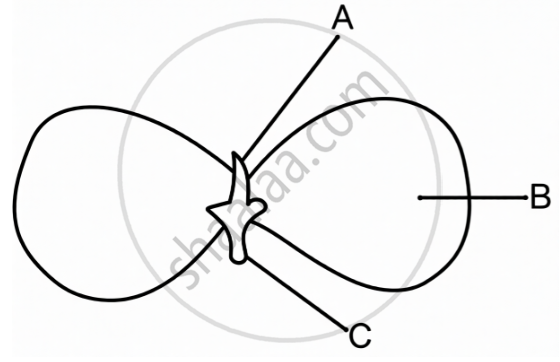
In the figure given alongside, the parts marked A, B and C are sequentially:
The correct sequence of reproductive stages occurring in flowering plants is ______.
The part of a seed which grows and develops into root on germination is :
(a) cotyledon
(b) plumule
(c) follicle
(d) radicle
What is a flower ? Draw a neat labelled diagram showing the L.S. of a typical flower.
State whether the following statement is true (T) or false (F):
Stamens make egg cells.
Find the odd-one out, giving reason:
Anther, pollen grain, ovule male gamete
Mention the function of Anther.
Draw a labelled diagram of a bisexual flower.
The students of a class were asked by the teacher to study the different parts of an embryo of an angiosperm. Given below are the essential steps for the experiment :
A. Soak the seeds in plain water and keep them overnight.
B. Cut open the soaked seed and observe its different parts.
C. Take some healthy seeds in a petri-dish.
D. Drain the excess water, cover the seeds with a wet cotton cloth and leave them as it is for a day.
The correct sequence of these steps is
(a) C, A, D, B
(b) C, D, A, B
(c) A, C, D, B
(d) A, C, B, D
In the figure, the parts marked A, B and C are sequentially:

(A) Plumule, Radicle and Cotyledon
(B) Radicle, Plumule and Cotyledon
(C) Plumule, Cotyledon and Radicle
(D) Radicle, Cotyledon and Plumule
Draw a diagram of a pistil showing pollen tube growth into the ovule and label the following:
Pollen grain, male gamete, female gamete, ovary.
Distinguish between unisexual and bisexual flowers giving one example of each. Draw a diagram showing process of germination of pollen grains on stigma and label the following parts:
(a) Female germ cell
(b) Male germ cell
(c) Ovary
Write the names of male and female reproductive parts of a flower.
List any two differences between pollination and fertilization.
Mention pollination types.
Answer the following question.
How does suitable pollination lead to fertilization?
Define.
Inflorescence
Match the following
| 1. | Petal | Opuntia |
| 2. | Fern | Chrysanthemum |
| 3. | Phylloclade | Attracts insect |
| 4. | Hooks | Spore |
| 5. | Sucker | Bignonia |
The ovule of an angiosperm is technically equivalent to ______
Flowers showing ornithophily show few characteristic like ______.
Length of pollen tube depends on the distance between ______
Complete the table
| Carly x | ______ | ______ |
| ______ | petal | attract insects |
| Androecium | ______ | Male reproductive part |
| ______ | ______ | Female reproductive part. |
In a bisexual flower inspite of the young stamens being removed artificially, the flower produces fruit. Provide a suitable explanation for the above situation.
Draw the diagram of a flower and label the four whorls. Write the names of gamete producing organs in the flower.
Double fertilization is essential for formation of ______.
What are the agents for pollination?
The figure below shows the concept of double fertilization. Complete the flow chart showing the progress at each step:

Type of sexual reproduction is ______.
Explain the post fertilization changes that occur in the ovary of a flower.
