Advertisements
Advertisements
Question
Explain the sexual reproduction process in plants with a diagram.
Advertisements
Solution
Sexual reproduction in plants:
- A flower is the functional unit of sexual reproduction in plants.
- The androecium and gynoecium are the male and female parts of the flower respectively.
- The female reproductive organ of a flower which gives rise to egg or female gamete is known as carpel. Ovary present at the base of the carpel contains ovules that undergo meiosis to form embryo sac.
- Stamen is the male reproductive part of a flower which gives rise to male gametes.
- In sexual reproduction of plants, pollination is a major step, which involves the transfer of pollen grains on the stigma of female flower.
- Stigma becomes sticky during pollination.
- The pollen grain germinates over the stigma and gives rise to the pollen tube.
- Pollen tube carries two male gametes which are released near egg cells present in the embryo sac.
- One male gamete fuses with a female gamete giving rise to zygote. The second male gamete fuses with two polar nuclei giving rise to endosperm. This is called as double fertilization.
- Zygote develops into embryo and endosperm serves as a nutritive tissue for the growing embryo.
- After fertilization, the ovule develops into seed and ovary into fruit. Seeds fall upon the ground and can develop into a new plant under favourable conditions.

APPEARS IN
RELATED QUESTIONS
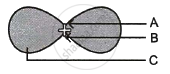
Name the parts labelled as A, B, C and D in the diagram given below:-

State significance of pollination.
Name and differentiate between the two modes of pollination in flowering plants.
Give one example of a unisexual flower.
State the function of flowers in the flowering plants.
A flower may have either male or female reproductive parts. Such a flower is called ______.
Name the part made up of the stigma, style and ovary.
What is the function of a flower?
Draw a neat sketch of the stamen of a flower. Mark in it filament and anther.
How is the process of pollination different from fertilization?
Name the part of a seed which grows into shoot.
Draw a neat diagram of a flower showing its various parts. In this diagram mark stem, receptacle, sepals, petals, stamen and carpel.
Which of the following statements are true for flowers?
(i) Flowers are always bisexual.
(ii) They contain sexual reproductive organs.
(iii) They are produced in all groups of plants.
(iv) after fertilization they give rise to fruits.
Which among the following statements are true for unisexual flowers?
(i) They possess both stamen and pistil
(ii) They possess either stamen or pistil
(iii) They exhibit cross pollination
(iv) Unisexual flower possessing only stamens cannot produce fruits
(a) (i) and (iv)
(b) (ii), (iii) and (iv)
(c) (ii) and (iii)
(d) (i), (iii) and (iv)
The part of a seed which grows and develops into root on germination is :
(a) cotyledon
(b) plumule
(c) follicle
(d) radicle
| When an insect sits on the flower of a plant then somene particles A present in the top of little stalks in the flower attach to its body hair. When this insect now sits on the flower of another similar plant, then particles A attached to the hair of insect are put on the top of a flask-shaped organ at the centre of flower. The particle A grows a long tube B from the top of flask-shaped organ through which C moves down and reaches the bottom part of flask-shaped organ. Here C fuses with the nucleus of D contained in structure E. The fusion of C and D forms a new cell F which grows and develops into a seed of the plant. |
- What are particles A? What is the process of transferring A from one flower to another flower of similar plant by the insect known as?
- What is the name of tube B?
- What is C which moves down through the tube B?
- Name D and E.
- What is F?
Fill in the blanks:
A stamen consists of ______ and ________.
State whether the following statement is true (T) or false (F):
Flowers which possess stamens and carpel are called unisexual.
Write one main difference between asexual and sexual mode of reproduction. Which species is likely to have comparatively better chances of survival – the one reproducing asexually or the one reproducing sexually? Give reason to justify your answer.
Give one example each of unisexual and bisexual flowers. Differentiate between the two types of pollination that occur in flowers. What happens when a pollen lands on a suitable stigma? Write about the events that occur till the seed formation in the ovary.
Identify A, B, C and D in the given diagram and write their names.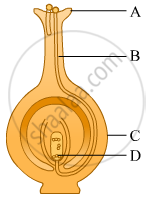
Identify the odd. Stigma, Style, Pollen, Ovary.
Fill in the blank by selecting suitable word:
Transfer of pollen grains from the anther to the stigma is known as______________.
Find an odd one out.
Give scientific reason.
Fertilization in plants is called double fertilization.
The anther wall consists of four wall layers where ______
Which of the following is the outermost protective layer of anther?
The 3-celled egg apparatus at the micropylar end comprises of ______
Sperm and egg nuclei fuse due to ______.
Conidia are formed endogenously while zoospores are formed endogenously.
Variations occur as a result of ______
Which among the following statements are true for unisexual flowers?
- They possess both stamen and pistil
- They possess either stamen or pistil
- They exhibit cross pollination
- Unisexual flowers possessing only stamens cannot produce fruits
Where is the zygote located in the flower after fertilization?
Trace the path a male gamete takes to fertilise a female gamete after being released from the penis.
Double fertilization is essential for formation of ______.
The pollen tube usually enters the embryo sac ______.
Given below is a diagram of a germinating seed. Label the parts that:
- gives rise to future shoot.
- gives rise to future root system.
- stores food.