Advertisements
Advertisements
Question
In a plant flower the female whorl is ______.
Options
Corolla
Calyx
Androecium
Gynoecium
Advertisements
Solution
In a plant flower the female whorl is Gynoecium.
APPEARS IN
RELATED QUESTIONS
Name the parts A, B and C shown in the diagram and write their functions.

Mention the changes a flower undergoes after fertilisation.
Write the names of those parts of a flower which serve the same function as the following do in the animals :
(i) testis,
(ii) sperm,
(iii) ovary,
(iv) egg
The reproductive part of a plant is the ______.
What is the name of female organ of a flower (other than carpel)?
Where is the male gamete formed in flowering plants?
Where is the female gamete formed in flowering plants?
Fill in the following blank with suitable word :
Pollen grains contain ............ gametes of a plant.
Fill in the following blank with suitable word :
The term used to refer to the transfer of pollen from the stamen of one flower to the carpel of another flower of the same species is...........
Draw a neat sketch of the stamen of a flower. Mark in it filament and anther.
What is seed?
Which of the following statements are true for sexual reproduction in flowering plants?
(i) it requires two types of gametes
(ii) fertilisation is a compulsory event
(iii) it always results in the formation of zygote
(iv) offsprings formed are clones
(a) (i) and (iv)
(b) (i), (ii) and (iv)
(c) (i), (ii) and (iii)
(d) (ii), (iii) and (iv)
In the figure given alongside, the parts marked A, B and C are sequentially:
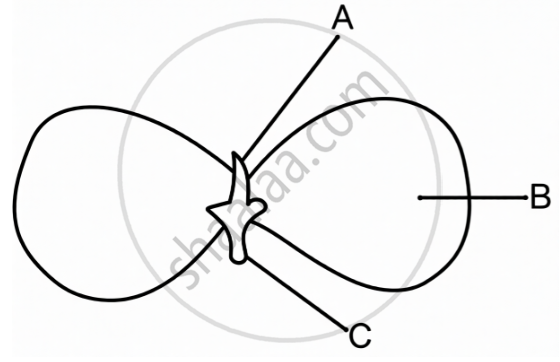
In a bisexual flower, inspite of the young stamens being removed artificially, the flower produces fruit. Explain.
Put a tick mark (✓) against the correct alternative in the following statement
Reproductive whorls of a flower are:
Multiple choice question. Tick (✓) the correct choice:
The male gamete is present inside the which germinates.
- the style
- the stigma
- the anther
- the ovary
Find the odd-one out, giving reason:
Anther, pollen grain, ovule male gamete
Mention the function of Flower.
What are the male and female gametes in a flowering plant?
A student is asked to study the different parts of an embryo of pea seeds. Given below are the essential steps for the experiment :
(I) Soak the pea seeds in plain water and keep them overnight.
(II) Cut open the soaked seed and observe its different parts.
(III) Take some pea seeds in a petri dish.
(IV) Drain the excess water. Cover the seeds with a wet cotton cloth and leave them as it is for a day.
The correct sequence of these steps is
(A) III, I, IV, II
(B) III, IV, I, II
(C) III, I, II, IV
(D) III, II, I, IV
Draw a diagram of the longitudinal section of a flower and label on it sepal, petal, ovary and stigma.
List any two differences between pollination and fertilization.
Mention pollination types.
What is meant by pollination?
Pollen grains are formed by _________ division in locules of anthers.
Bisexual : Hibiscus : : Unisexual : ___________
Accessory whorls : Calyx and corolla : : essential whorls : ______________
Pollen tube reaches the embryo sac via style.
Write the functions of sepals
Match the following
| 1. | Petal | Opuntia |
| 2. | Fern | Chrysanthemum |
| 3. | Phylloclade | Attracts insect |
| 4. | Hooks | Spore |
| 5. | Sucker | Bignonia |
Where does the endothecium layer of anther lobes is present?
The ovule of an angiosperm is technically equivalent to ______
Which type of development is observed in male gametophytes of plants?
Pollen grains are produced by ______
Give any two examples of agents of pollination.
What is the function of calyx?
Sexual maturation of reproductive tissues and organs are necessary link for reproduction. Elucidate.
- Assertion: Primary endosperm nucleus is diploid.
- Reason: It is the product of double fertilisation.
In male reproductive whorl of a flower the archesporial cells are formed by ______.
