Advertisements
Advertisements
Question
Match the following:
| Column A | Column B |
| (i) Stigma | (a) Neuron |
| (ii) Pepsin | (b) Carpel |
| (iii) Dendrites | (c) Protein |
| (d) Stamen |
Advertisements
Solution
| Column A | Column B |
| i. Stigma | (b) Carpel |
| ii. Pepsin | (c) Protein |
| iii. Dendrites | (a) Neuron |
APPEARS IN
RELATED QUESTIONS
Give one example of a unisexual flower.
State the function of flowers in the flowering plants.
A flower may have either male or female reproductive parts. Such a flower is called ______.
The process of fusion of the male and female gametes is called ______.
Name the male part of the flower.
Where are the pollen grains produced?
Fill in the following blank with suitable word :
Pollen grains contain ............ gametes of a plant.
Fill in the following blank with suitable word :
Ovules contain ......... gametes of a plant.
Fill in the following blank with suitable word :
The male organ of reproduction in the flower is the.......... .
How is the process of pollination different from fertilization?
Explain the term 'fertilisation'.
What is seed?
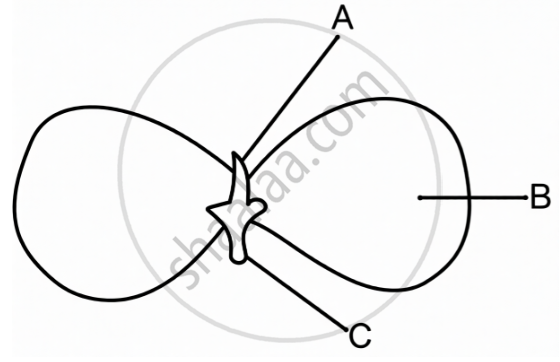
In the figure given alongside, the parts marked A, B and C are sequentially:
Put a tick mark (✓) against the correct alternative in the following statement
Pollen is produced in the:
Fill in the blank by selecting suitable word:
A flower bearing only male or female parts is known as __________ flower.
What is a flower ? Draw a neat labelled diagram showing the L.S. of a typical flower.
Mention the function of Stigma.
What part is played by stamens and carpels in reproduction?
Draw a diagram of the longitudinal section of a flower exhibiting germination of pollen on stigma and label (i) ovary, (ii) male germ-cell, (iii) female germ-cell and (iv) ovule on it.
Explain the process of fertilisation in flowers.
What is cleistogamy? Write one advantage and one disadvantage of it, to the plant.
Find an odd one out.
Bisexual : Hibiscus : : Unisexual : ___________
Pollen tube reaches the embryo sac via style.
Draw a neat and labelled diagram.
Double fertilization in angiosperms
Write the events involved in the sexual reproduction of a flowering plant.
a. Discuss the first event and write the types.
b. Mention the advantages and the disadvantages of that event.
Antipodal cells are present towards the ______ in an anatropous ovule.
The 3-celled egg apparatus at the micropylar end comprises of ______
Sperm and egg nuclei fuse due to ______.
The seed that contains the future plant is called the ______
The process of release of eggs from the ovary is called ______
In human beings, fertilization occurs in the ______
Which out of the following processes does not lead to the formation of clones.
Where is the zygote located in the flower after fertilization?
Double fertilization means ______.
Consider the following three flowers namely X, Y and Z. Which flower(s) would develop into a fruit?
| Flower X | Flower Y | Flower Z |
 |
 |
 |
