Advertisements
Advertisements
Question
What does germination mean?
Advertisements
Solution 1
Zygote utilizes food stored in endosperm of seed and a new plantlet is formed. This is called as seed germination.
Solution 2
The process through which seeds develop into seedlings is known as germination.
APPEARS IN
RELATED QUESTIONS
Give one example of a unisexual flower.
You are asked by your teacher to study the different parts of an embryo of a gram seed. Given below are the steps to be followed for the experiment:
I. Soak the gram seeds in plain water and keep them overnight.
II. Cut open a soaked seed and observe its different parts.
III. Take some dry gram seeds in a petri dish.
IV. Drain the excess water.
V. Cover the soaked seeds with a wet cotton cloth and leave them for a day.
The correct sequence of these steps is :
(A) III, I, V, IV, II
(B) III, I, II, IV, V
(C) III, IV, V, I, II
(D) III, I, IV, V, II
The reproductive part of a plant is the ______.
Name the part made up of the stigma, style and ovary.
What is the name of female part of a flower?
Where is the female gamete formed in flowering plants?
Fill in the following blank with suitable word :
The ovary of a flower becomes ....... after fertilisation.
Explain the terms 'self pollination'
Name the part of a seed which grows into shoot.
How does pollination occur?
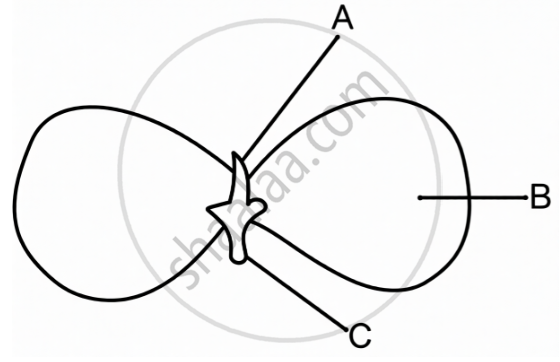
In the figure given alongside, the parts marked A, B and C are sequentially:
The correct sequence of reproductive stages occurring in flowering plants is ______.
In a bisexual flower, inspite of the young stamens being removed artificially, the flower produces fruit. Explain.
Multiple choice question. Tick (✓) the correct choice:
The male gamete is present inside the which germinates.
- the style
- the stigma
- the anther
- the ovary
Fill in the blank:
Seeds are formed from________.
State whether the following statement is true (T) or false (F):
Stamens make egg cells.
Mention the function of Stigma.
Write one main difference between asexual and sexual mode of reproduction. Which species is likely to have comparatively better chances of survival – the one reproducing asexually or the one reproducing sexually? Give reason to justify your answer.
Describe an activity to demonstrate phototropism.
List any two differences between pollination and fertilization.
Identify the odd. Stigma, Style, Pollen, Ovary.
Fill in the blanks and rewrite the completed statements:
Lymph flows in _______________ direction.
Mention pollination types.
Pollen grains from anther are transferred to the stigma.
Give scientific reason.
Fertilization in plants is called double fertilization.
The anther wall consists of four wall layers where ______
Antipodal cells are present towards the ______ in an anatropous ovule.
How many middle layers are generally present in the wall of the anther lobes?
Gloriosa superba exhibits ______.
The seed that contains the future plant is called the ______
The process of release of eggs from the ovary is called ______
Length of pollen tube depends on the distance between ______
Which among the following statements are true for sexual reproduction in flowering plants?
- It requires two types of gametes
- Fertilisation is a compulsory event
- It always results in formation of zygote
- Offspring formed are clones
Where is the zygote located in the flower after fertilization?
State the number of sets of chromosomes present in a zygote.
Double fertilization is essential for formation of ______.
Sketch and label the essential and accessory whorls of flower.
Triple fusion involves ______.
Name the reproductive parts of an angiosperm. Where are these parts located? Explain the structure of its male reproductive part.
- Assertion: Primary endosperm nucleus is diploid.
- Reason: It is the product of double fertilisation.
