Advertisements
Advertisements
Question
Pollen grains from anther are transferred to the stigma.
Options
True
False
Advertisements
Solution
True
APPEARS IN
RELATED QUESTIONS
Match the following:
| Column A | Column B |
| (i) Stigma | (a) Neuron |
| (ii) Pepsin | (b) Carpel |
| (iii) Dendrites | (c) Protein |
| (d) Stamen |
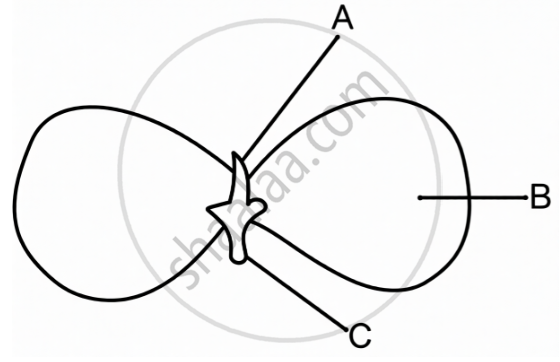
Name the parts A, B and C shown in the following diagram and state one function of each.

A student has to perform the experiment "To identify the different parts of an embryo of a dicot seed." Select from the following an appropriate group of seeds:
(a) Pea, gram, wheat
(b) Red kidney bean, maize, gram
(c) Maize, wheat, red kidney bean
(d) Red kidney bean, pea, gram
State significance of pollination.
Give one example of a unisexual flower.
Where are a plant's sex organs located?
What is the name of female organ of a flower (other than carpel)?
Fill in the following blank with suitable word :
Pollen grains contain ............ gametes of a plant.
Fill in the following blank with suitable word :
Ovules contain ......... gametes of a plant.
Fill in the following blank with suitable word :
The male organ of reproduction in the flower is the.......... .
Fill in the following blank with suitable word :
The term used to refer to the transfer of pollen from the stamen of one flower to the carpel of another flower of the same species is...........
Give some examples of different modes of fertilisation in nature?
Name the part of a seed which grows into root.
Name the part of a seed which grows into shoot.
What is meant by ‘unisexual flowers’?
Draw a neat diagram of a flower showing its various parts. In this diagram mark stem, receptacle, sepals, petals, stamen and carpel.
Which among the following statements are true for unisexual flowers?
(i) They possess both stamen and pistil
(ii) They possess either stamen or pistil
(iii) They exhibit cross pollination
(iv) Unisexual flower possessing only stamens cannot produce fruits
(a) (i) and (iv)
(b) (ii), (iii) and (iv)
(c) (ii) and (iii)
(d) (i), (iii) and (iv)
In the figure given alongside, the parts marked A, B and C are sequentially:
The part of a seed which grows and develops into root on germination is :
(a) cotyledon
(b) plumule
(c) follicle
(d) radicle
In what ways is fertilisation in a plant different from fertilisation in a human?
Fill in the blank by selecting suitable word:
A flower that bears both the male and the female parts is known as __________ flower.
Multiple choice question. Tick (✓) the correct choice:
The male gamete is present inside the which germinates.
- the style
- the stigma
- the anther
- the ovary
Find the odd-one out, giving reason:
Anther, pollen grain, ovule male gamete
Mention the function of Stigma.
Write one main difference between asexual and sexual mode of reproduction. Which species is likely to have comparatively better chances of survival – the one reproducing asexually or the one reproducing sexually? Give reason to justify your answer.
You have to perform the experiment, "To identify the different parts of an embryo of a gram seed." Describe the procedure that you would follow.
Draw a diagram of the longitudinal section of a flower and label on it sepal, petal, ovary and stigma.
What is phototropism?
Find an odd one out.
Find an odd one out.
Observe the figure below. Write functions of the labelled parts.

The essential parts of a flower are ______.
Which of the following are the chemical components of the wall of pollen tube?
Pineapple fruit develops from ______.
Which among the following statements are true for unisexual flowers?
- They possess both stamen and pistil
- They possess either stamen or pistil
- They exhibit cross pollination
- Unisexual flowers possessing only stamens cannot produce fruits
State the number of sets of chromosomes present in a zygote.
In a plant flower the female whorl is ______.
Sexual maturation of reproductive tissues and organs are necessary link for reproduction. Elucidate.
