English

Fill in the Following Blank with Suitable Word : The.......... at the Base of the Carpel Contains Egg Cells. - Science

Advertisements
Advertisements

Question

Fill in the following blank with suitable word :

The.......... at the base of the carpel contains egg cells.

Advertisements

Solution

The ovary at the base of the carpel contains egg cells.

shaalaa.com
  Is there an error in this question or solution?
Chapter 3: How do Organisms Reproduce? - Exercise 2 [Page 168]

APPEARS IN

Lakhmir Singh Biology (Science) [English] Class 10
Chapter 3 How do Organisms Reproduce?
Exercise 2 | Q 25.09 | Page 168

Video TutorialsVIEW ALL [1]

RELATED QUESTIONS

How does fertilisation occur in flowers? Name the parts of the flower that develop into (i) seed, and (ii) fruit after fertilisation.


What are the reproductive organs in a flower?


Where is the male gamete formed  in flowering plants?


Fill in the following blank with suitable word : 

Pollen grains contain ............ gametes of a plant.


What is pollination? How does pollination occur?


Which of the following is the correct sequence of events of sexual reproduction in a flower?
(a) pollination, fertilisation, seed, embryo
(b) seed, embryo, fertilisation, pollination
(c) pollination, fertilisation, embryo, seed
(d) embryo, seed, pollination, fertilisation


The flask-shaped organ A at the centre of a flower is surrounded by a number of little stalks B having swollen tops which lie just inside the ring of petals.
(a) Name A. What are the various parts of A?
(b) Which part of A contains gametes?
(c) Name B. What is the swollen top of B known as?
(d) What does the swollen top of b contain?
(e) Out of A and B, which one is (i) male part, and (ii) female part of the flower?


Write one main difference between asexual and sexual mode of reproduction. Which species is likely to have comparatively better chances of survival – the one reproducing asexually or the one reproducing sexually? Give reason to justify your answer.


A student is asked to study the different parts of an embryo of pea seeds. Given below are the essential steps for the experiment :
(I) Soak the pea seeds in plain water and keep them overnight.
(II) Cut open the soaked seed and observe its different parts.
(III) Take some pea seeds in a petri dish.
(IV) Drain the excess water. Cover the seeds with a wet cotton cloth and leave them as it is for a day.
The correct sequence of these steps is
(A) III, I, IV, II
(B) III, IV, I, II
(C) III, I, II, IV
(D) III, II, I, IV


In the figure, the parts marked A, B and C are sequentially:
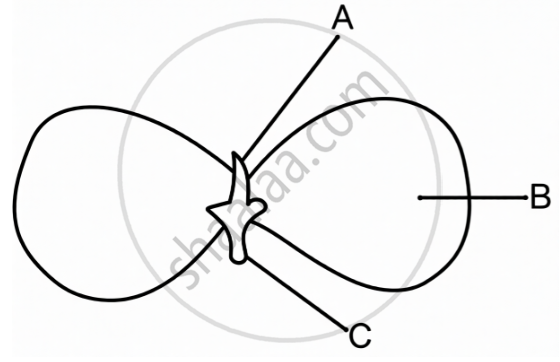

(A) Plumule, Radicle and Cotyledon

(B) Radicle, Plumule and Cotyledon

(C) Plumule, Cotyledon and Radicle

(D) Radicle, Cotyledon and Plumule


“Cell division is a type of reproduction in unicellular organism.” Justify.


Draw a diagram of a pistil showing pollen tube growth into the ovule and label the following:

Pollen grain, male gamete, female gamete, ovary.


Explain sexual reproduction in plants. 


Answer the following question.
How does suitable pollination lead to fertilization?


A student is observing the temporary mount of a leaf peel under a microscope. Draw a labelled diagram of the structure of stomata as seen under the microscope


What is cleistogamy? Write one advantage and one disadvantage of it, to the plant.


Pollen grains from anther are transferred to the stigma.


Draw a neat and labelled diagram.

Double fertilization in angiosperms


How many middle layers are generally present in the wall of the anther lobes?


Trace the path a male gamete takes to fertilise a female gamete after being released from the penis.


Share
Notifications

Englishहिंदीमराठी


      Forgot password?
Use app×