Advertisements
Advertisements
प्रश्न
Give any two examples of agents of pollination.
Advertisements
उत्तर
Examples of agents of pollination are:
- Insect pollination: Bees are the most common and recognized insect pollinators.
- Bird pollination: Plants are pollinated by some birds, particularly hummingbirds.
APPEARS IN
संबंधित प्रश्न
A student has to perform the experiment "To identify the different parts of an embryo of a dicot seed." Select from the following an appropriate group of seeds:
(a) Pea, gram, wheat
(b) Red kidney bean, maize, gram
(c) Maize, wheat, red kidney bean
(d) Red kidney bean, pea, gram
Give one example of a unisexual flower.
Explain what you understand by sexual reproduction.
Sketch the reproductive parts of a flower.
Name the male part of the flower.
What is the name of female organ of a flower (other than carpel)?
Fill in the following blank with suitable word :
Ovules contain ......... gametes of a plant.
What type of plants reproduce by sexual reproduction method?
In tobacco plant, the male gametes have 24 chromosomes.
What is the number of chromosomes in the female gamete?
Draw a neat diagram of a flower showing its various parts. In this diagram mark stem, receptacle, sepals, petals, stamen and carpel.
The part of a seed which grows and develops into root on germination is :
(a) cotyledon
(b) plumule
(c) follicle
(d) radicle
The flask-shaped organ A at the centre of a flower is surrounded by a number of little stalks B having swollen tops which lie just inside the ring of petals.
(a) Name A. What are the various parts of A?
(b) Which part of A contains gametes?
(c) Name B. What is the swollen top of B known as?
(d) What does the swollen top of b contain?
(e) Out of A and B, which one is (i) male part, and (ii) female part of the flower?
Identify A, B, C and D in the given diagram and write their names.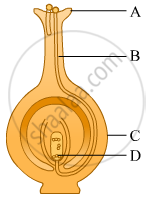
A student is asked to study the different parts of an embryo of pea seeds. Given below are the essential steps for the experiment :
(I) Soak the pea seeds in plain water and keep them overnight.
(II) Cut open the soaked seed and observe its different parts.
(III) Take some pea seeds in a petri dish.
(IV) Drain the excess water. Cover the seeds with a wet cotton cloth and leave them as it is for a day.
The correct sequence of these steps is
(A) III, I, IV, II
(B) III, IV, I, II
(C) III, I, II, IV
(D) III, II, I, IV
Write the names of male and female reproductive parts of a flower.
List any two differences between pollination and fertilization.
Identify the odd. Stigma, Style, Pollen, Ovary.
Sketch the labelled diagram.
Flower with its sexual reproductive organs.
Prepare a slogan for campaign against female foeticide.
Answer the following question.
How does suitable pollination lead to fertilization?
Pollen grains are formed by _________ division in locules of anthers.
The essential parts of a flower are ______.
What would be the number of chromosomes in the cells of the aleurone layer in a plant species with 8 chromosomes in its synergids?
Variations occur as a result of ______
State the number of sets of chromosomes present in a zygote.
Double fertilization is exhibited by ______
Sketch and label the essential and accessory whorls of flower.
What are the agents for pollination?
What is the function of calyx?
The figure below shows the concept of double fertilization. Complete the flow chart showing the progress at each step:

Sexual maturation of reproductive tissues and organs are necessary link for reproduction. Elucidate.
Consider the following three flowers namely X, Y and Z. Which flower(s) would develop into a fruit?
| Flower X | Flower Y | Flower Z |
 |
 |
 |
In male reproductive whorl of a flower the archesporial cells are formed by ______.
