Advertisements
Advertisements
प्रश्न
Complete the table.
| Sex/Gender | Reasons of infertility |
| Female | |
| Male |
Advertisements
उत्तर
| Sex/Gender | Reasons of infertility |
| Female | Irregularity in menstrual cycle, difficulties in oocyte production, obstacles in the oviduct, difficulties in implantation in uterus |
| Male | Absence of sperms in the semen, slow movement of sperms, anomalies in the sperms |
APPEARS IN
संबंधित प्रश्न
Given here is a section of the female reproductive system of human beings.
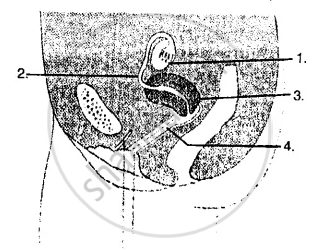
Name the parts labelled 1 to 4
Mention the functions of Ovary.
Choose the odd one in each of the following:
Sperm; implantation; fertilization; ovum; ovum; after birth.
After puberty human female shows cyclic changes in her reproductive system. Explain structural and hormonal changes in the uterus.
(OR)
Give reasons :
(1) Scrotal sac serves as thermoregulator.
(2) Corpus luteum gets converted into corpus albicans in absence of fertilization.
(3) Missing of menses is the first indication of pregnancy.
(4) Surgical sterilization is a permanent method of birth control. (5) Human egg is microlecithal.
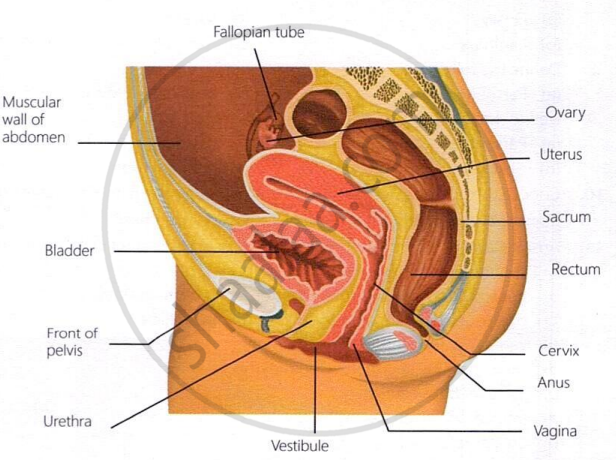
The diagram alongside is the vertical section of female reproductive organs. Study the diagram and answer the questions that follow:
- Name the fully developed part of ovary containing the ovum.
- Name the organ of the female body in which the foetus develops.
- What is ovulation?
- Which two hormones are secreted by ovary?
The implantation of the embryo occurs at about ______ days of fertilization.
Which of the following are accessory ducts of female reproductive system?
Which part of the fallopian tube collects to ovum after ovulation?
The development of lactiferous tubules during pregnancy is dependent on ____________.
Where does the ovum receive the sperm?
Which of the following is correct about mammalian testes?
To produce 400 seeds, the number of meiotic divisions required will be ______
The embryo in humans gets nutrition from the mother’s blood with the help of a special tissue called ______
Read the following and answer from given below:
During copulation, semen is released by the penis into the vegina. The motile sperms swim rapidly, fuse with the ovum in the ampullary region, resulting in fertilization. The haploid nucleus of sperm fuses with that of the ovum to form a diploid zygote.
In the female genital tract, sperms are made capable of fertilizing the egg. This phenomenon of sperm activation is called ______
Read the following and answer from given below:
During copulation, semen is released by the penis into the vegina. The motile sperms swim rapidly, fuse with the ovum in the ampullary region, resulting in fertilization. The haploid nucleus of sperm fuses with that of the ovum to form a diploid zygote.
Select the correct sequence of various physical and chemical events that take place during fertilisation.
P. Fusion of cortical granules with the plasma membrane of secondary oocyte.
Q. Formation of fertilization cone to receive sperm.
R. Release of sperm lysin from acrosome.
S. Mixing up of chromosomes of a sperm and an ovum.
______ acts as a birth canal.
Bartholin's glands are homologous to ______.
Write the specific location of the following:
Vagina
Which combination correctly identifies the stroma zones of the ovary?
Where do alveoli store milk?
