Advertisements
Advertisements
प्रश्न
What are the agents for pollination?
Advertisements
उत्तर
Pollination occurs with the help of abiotic agents (wind, water) and biotic agents (insects and other animals).
APPEARS IN
संबंधित प्रश्न
A student while observing an embryo of a pea seed in the laboratory listed various parts of the embryo as given below:
Testa, Tegmen, Radicle, Plumule, Micropyle, Cotyledon.
On examining the list the teacher remarked that only three parts are correct. Select three correct parts from the above list:
(a) Testa, Radicle, Cotyleddon
(b) Tegmen, Radicle, Micropyle
(c) Cotyledon, Plumule, Testa
(d) Radicle, Cotyledon, Plumule
Name the parts A, B and C shown in the following diagram and state one function of each.

State significance of pollination.
A flower may have either male or female reproductive parts. Such a flower is called ______.
The fusion of male and female gametes is termed as ______.
Draw a neat sketch of the stamen of a flower. Mark in it filament and anther.
What is made in anther of a flower?
Explain the term 'fertilisation'.
How does pollination occur?
Describe the process of fertilisation in a flower with the help of labelled diagrams.
The length of pollen tube depends on the distance between :
(a) pollen grain and upper surface of stigma
(b) pollen grain on upper surface of stigma and ovule
(c) pollen grain in anther and upper surface of stigma
(d) upper surface of stigma and lower part of style
The part of a seed which grows and develops into root on germination is :
(a) cotyledon
(b) plumule
(c) follicle
(d) radicle
The flask-shaped organ A at the centre of a flower is surrounded by a number of little stalks B having swollen tops which lie just inside the ring of petals.
(a) Name A. What are the various parts of A?
(b) Which part of A contains gametes?
(c) Name B. What is the swollen top of B known as?
(d) What does the swollen top of b contain?
(e) Out of A and B, which one is (i) male part, and (ii) female part of the flower?
Put a tick mark (✓) against the correct alternative in the following statement
Pollen is produced in the:
What is a flower ? Draw a neat labelled diagram showing the L.S. of a typical flower.
Fill in the blanks:
A stamen consists of ______ and ________.
Draw a labelled diagram of a bisexual flower.
Give one example each of unisexual and bisexual flowers. Differentiate between the two types of pollination that occur in flowers. What happens when a pollen lands on a suitable stigma? Write about the events that occur till the seed formation in the ovary.
(a) Identify A, B and C in the given diagram and write their functions.
(b) Mention the role of gamete and zygote in sexually reproducing organisms.
Sketch the labelled diagram.
Flower with its sexual reproductive organs.
Pollen grains are formed by _________ division in locules of anthers.
__________ is present in unisexual flower.
Find an odd one out.
Give scientific reason.
Fertilization in plants is called double fertilization.
The male reproductive part of a flower is ______.
Match the following
| 1. | Petal | Opuntia |
| 2. | Fern | Chrysanthemum |
| 3. | Phylloclade | Attracts insect |
| 4. | Hooks | Spore |
| 5. | Sucker | Bignonia |
Identify the parts A, B, C, and D?
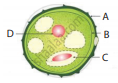
Write the events involved in the sexual reproduction of a flowering plant.
Discuss the first event and write the types.
The 3-celled egg apparatus at the micropylar end comprises of ______
Conidia are formed endogenously while zoospores are formed endogenously.
The seed that contains the future plant is called the ______
Which among the following statements are true for unisexual flowers?
- They possess both stamen and pistil
- They possess either stamen or pistil
- They exhibit cross pollination
- Unisexual flowers possessing only stamens cannot produce fruits
Sketch and label the essential and accessory whorls of flower.
In a plant flower the female whorl is ______.
What is the structural unit of sexual reproduction in plant?
Type of sexual reproduction is ______.
Consider the following three flowers namely X, Y and Z. Which flower(s) would develop into a fruit?
| Flower X | Flower Y | Flower Z |
 |
 |
 |
- Assertion: Primary endosperm nucleus is diploid.
- Reason: It is the product of double fertilisation.
