Advertisements
Advertisements
प्रश्न
__________ is present in unisexual flower.
विकल्प
Both androecium and gynoecium
Only androecium
Only gynoecium
Androecium or gynoecium
Advertisements
उत्तर
Androecium or gynoecium is present in unisexual flower.
APPEARS IN
संबंधित प्रश्न
A student was asked to observe and identify the various parts of an embryo of a red kidney bean seed. He identified the parts and listed them as under:
I. Tegmen
II. Testa
III. Cotyledon
IV. Radicle
V. Plumule
The correctly identified parts among these are
(A) I, II and III
(B) II, III and IV
(C) III, IV and V
(D) I, III, IV and V

(i) Name the part marked 'A' in the diagram.
(ii) How dose 'A' reachese part 'B'?
(iii) State the importance of the part 'C'.
(iv) What happens to the part marked 'D' after fertilisation is over?
Mention the changes a flower undergoes after fertilisation.
State the function of flowers in the flowering plants.
A flower may have either male or female reproductive parts. Such a flower is called ______.
Where are the pollen grains produced?
What is the function of a flower?
What is the name of female part of a flower?
What is the name of female organ of a flower (other than carpel)?
Fill in the following blank with suitable word :
The ovary of a flower becomes ....... after fertilisation.
Fill in the following blank with suitable word :
Flowering plants reproduce by ...........method of reproduction.
Fill in the following blank with suitable word :
The male organ of reproduction in the flower is the.......... .
Fill in the following blank with suitable word :
The.......... at the base of the carpel contains egg cells.
What is made in ovary of a flower?
Explain the terms 'self pollination'
Draw a neat diagram of a flower showing its various parts. In this diagram mark stem, receptacle, sepals, petals, stamen and carpel.
Which among the following statements are true for unisexual flowers?
(i) They possess both stamen and pistil
(ii) They possess either stamen or pistil
(iii) They exhibit cross pollination
(iv) Unisexual flower possessing only stamens cannot produce fruits
(a) (i) and (iv)
(b) (ii), (iii) and (iv)
(c) (ii) and (iii)
(d) (i), (iii) and (iv)
In the figure given alongside, the parts marked A, B and C are sequentially:
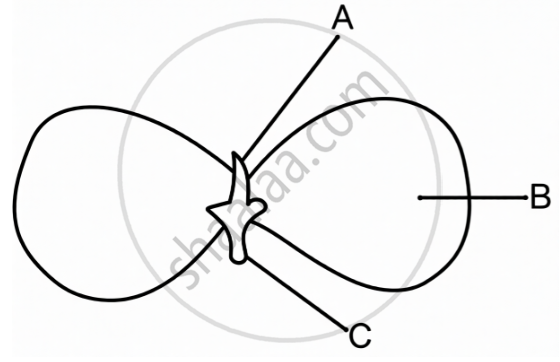
Put a tick mark (✓) against the correct alternative in the following statement
Reproductive whorls of a flower are:
What are the male and female gametes in a flowering plant?
Draw a labelled diagram of a bisexual flower.
Which of the following is not an unisexual flower?
a) Coconut
b) Papaya
c) Gulmohor
d) Maize
Identify the odd. Stigma, Style, Pollen, Ovary.
Explain sexual reproduction in plants.
Draw a diagram of the longitudinal section of a flower and label the following parts.
What does germination mean?
Give scientific reason.
Flower is a structural unit of sexual reproduction in plants.
Where does the endothecium layer of anther lobes is present?
Which of the following are the chemical components of the wall of pollen tube?
Generally, in a pollen tube, which of the following moves to the tip of the tube?
Which among the following statements are true for unisexual flowers?
- They possess both stamen and pistil
- They possess either stamen or pistil
- They exhibit cross pollination
- Unisexual flowers possessing only stamens cannot produce fruits
Is the chromosome number of zygote, embryonal cells and adult of a particular organism always constant? How is the constancy maintained in these three stages?
Where is the zygote located in the flower after fertilization?
Trace the path a male gamete takes to fertilise a female gamete after being released from the penis.
Double fertilization is essential for formation of ______.
Give any two examples of agents of pollination.
- Assertion: Primary endosperm nucleus is diploid.
- Reason: It is the product of double fertilisation.
