Advertisements
Advertisements
प्रश्न
Find an odd one out.
विकल्प
Hibiscus
Papaya
Sun-flower
Rose
Mango
Advertisements
उत्तर
Papaya
APPEARS IN
संबंधित प्रश्न

(i) Name the part marked 'A' in the diagram.
(ii) How dose 'A' reachese part 'B'?
(iii) State the importance of the part 'C'.
(iv) What happens to the part marked 'D' after fertilisation is over?
Name and differentiate between the two modes of pollination in flowering plants.
Name the parts labelled as A, B, C and D in the diagram given below:

Give one example of a unisexual flower.
The fusion of male and female gametes is termed as ______.
How does the process of fertilisation take place in flowers?
The reproductive part of a plant is the ______.
Name the swollen lower part of the carpel.
Where are the pollen grains produced?
Fill in the following blank with suitable word :
The female organ of reproduction in the flower is the...........
Fill in the following blank with suitable word :
The.......... at the base of the carpel contains egg cells.
Explain the term 'fertilisation'.
What is seed?
In tobacco plant, the male gametes have 24 chromosomes.
What is the number of chromosomes in the zygote?
Which among the following statements are true for unisexual flowers?
(i) They possess both stamen and pistil
(ii) They possess either stamen or pistil
(iii) They exhibit cross pollination
(iv) Unisexual flower possessing only stamens cannot produce fruits
(a) (i) and (iv)
(b) (ii), (iii) and (iv)
(c) (ii) and (iii)
(d) (i), (iii) and (iv)
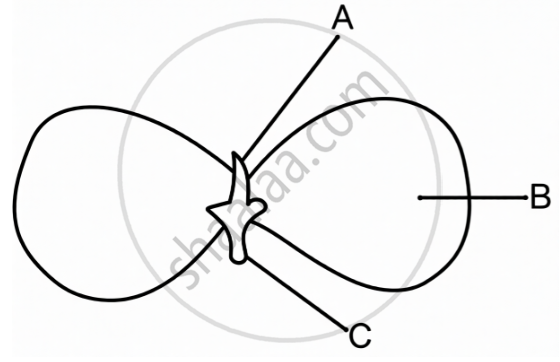
In the figure given alongside, the parts marked A, B and C are sequentially:
The correct sequence of reproductive stages occurring in flowering plants is ______.
Fill in the blanks:
A carpel consists of ________ , ________ and ________.
What is phototropism?
Prepare a slogan for campaign against female foeticide.
What is meant by pollination?
Accessory whorls : Calyx and corolla : : essential whorls : ______________
Write the functions of sepals
Distinguish between self-pollination and cross-pollination.
Write the events involved in the sexual reproduction of a flowering plant.
Discuss the first event and write the types.
Write the events involved in the sexual reproduction of a flowering plant.
a. Discuss the first event and write the types.
b. Mention the advantages and the disadvantages of that event.
The ovule of an angiosperm is technically equivalent to ______
How many middle layers are generally present in the wall of the anther lobes?
The seed that contains the future plant is called the ______
Is the chromosome number of zygote, embryonal cells and adult of a particular organism always constant? How is the constancy maintained in these three stages?
State the number of sets of chromosomes present in a zygote.
Double fertilization means ______.
What is the structural unit of sexual reproduction in plant?
What is the function of calyx?
Name the reproductive parts of an angiosperm. Where are these parts located? Explain the structure of its male reproductive part.
