Advertisements
Advertisements
प्रश्न
Find an odd one out.
पर्याय
Hibiscus
Papaya
Sun-flower
Rose
Mango
Advertisements
उत्तर
Papaya
APPEARS IN
संबंधित प्रश्न
Name the parts labelled as A, B, C and D in the diagram given below:-

How does fertilisation occur in flowers? Name the parts of the flower that develop into (i) seed, and (ii) fruit after fertilisation.
In the following diagram showing the structure of embryo of a dicot seed, what are the parts marked I, II and III sequentially?

A student while observing an embryo of a pea seed in the laboratory listed various parts of the embryo as given below:
Testa, Tegmen, Radicle, Plumule, Micropyle, Cotyledon.
On examining the list the teacher remarked that only three parts are correct. Select three correct parts from the above list:
(a) Testa, Radicle, Cotyleddon
(b) Tegmen, Radicle, Micropyle
(c) Cotyledon, Plumule, Testa
(d) Radicle, Cotyledon, Plumule
A student has to perform the experiment "To identify the different parts of an embryo of a dicot seed." Select from the following an appropriate group of seeds:
(a) Pea, gram, wheat
(b) Red kidney bean, maize, gram
(c) Maize, wheat, red kidney bean
(d) Red kidney bean, pea, gram
Give one example of a unisexual flower.
A flower may have either male or female reproductive parts. Such a flower is called ______.
What is seed?
Name the part of a seed which contains stored food.
Draw a neat diagram of a flower showing its various parts. In this diagram mark stem, receptacle, sepals, petals, stamen and carpel.
Which of the following statements are true for flowers?
(i) Flowers are always bisexual.
(ii) They contain sexual reproductive organs.
(iii) They are produced in all groups of plants.
(iv) after fertilization they give rise to fruits.
The part of a seed which grows and develops into root on germination is :
(a) cotyledon
(b) plumule
(c) follicle
(d) radicle
The flask-shaped organ A at the centre of a flower is surrounded by a number of little stalks B having swollen tops which lie just inside the ring of petals.
(a) Name A. What are the various parts of A?
(b) Which part of A contains gametes?
(c) Name B. What is the swollen top of B known as?
(d) What does the swollen top of b contain?
(e) Out of A and B, which one is (i) male part, and (ii) female part of the flower?
| When an insect sits on the flower of a plant then somene particles A present in the top of little stalks in the flower attach to its body hair. When this insect now sits on the flower of another similar plant, then particles A attached to the hair of insect are put on the top of a flask-shaped organ at the centre of flower. The particle A grows a long tube B from the top of flask-shaped organ through which C moves down and reaches the bottom part of flask-shaped organ. Here C fuses with the nucleus of D contained in structure E. The fusion of C and D forms a new cell F which grows and develops into a seed of the plant. |
- What are particles A? What is the process of transferring A from one flower to another flower of similar plant by the insect known as?
- What is the name of tube B?
- What is C which moves down through the tube B?
- Name D and E.
- What is F?
Put a tick mark (✓) against the correct alternative in the following statement
Pollen is produced in the:
Multiple choice question. Tick (✓) the correct choice:
The male gamete is present inside the which germinates.
- the style
- the stigma
- the anther
- the ovary
Identify A, B, C and D in the given diagram and write their names.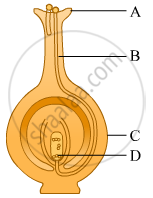
A student is asked to study the different parts of an embryo of pea seeds. Given below are the essential steps for the experiment :
(I) Soak the pea seeds in plain water and keep them overnight.
(II) Cut open the soaked seed and observe its different parts.
(III) Take some pea seeds in a petri dish.
(IV) Drain the excess water. Cover the seeds with a wet cotton cloth and leave them as it is for a day.
The correct sequence of these steps is
(A) III, I, IV, II
(B) III, IV, I, II
(C) III, I, II, IV
(D) III, II, I, IV
In the figure, the parts marked A, B and C are sequentially:

(A) Plumule, Radicle and Cotyledon
(B) Radicle, Plumule and Cotyledon
(C) Plumule, Cotyledon and Radicle
(D) Radicle, Cotyledon and Plumule
“Cell division is a type of reproduction in unicellular organism.” Justify.
Write the names of male and female reproductive parts of a flower.
List any two differences between pollination and fertilization.
Mention pollination types.
Draw a diagram of the longitudinal section of a flower and label the following parts.
Differentiate between self-pollination and cross-pollination.
Answer the following question.
List two agents of pollination?
__________ is present in unisexual flower.
Define.
Inflorescence
Give scientific reason.
Fertilization in plants is called double fertilization.
Where does the endothecium layer of anther lobes is present?
In which of the following manner the arrangement of megaspores in a tetrad is observed in angiosperms?
The 3-celled egg apparatus at the micropylar end comprises of ______
Draw the diagram of a flower and label the four whorls. Write the names of gamete producing organs in the flower.
The ovaries of different flowers may contain ______.
Trace the path a male gamete takes to fertilise a female gamete after being released from the penis.
Type of sexual reproduction is ______.
- Assertion: Primary endosperm nucleus is diploid.
- Reason: It is the product of double fertilisation.
