Advertisements
Advertisements
प्रश्न
The part of a seed which grows and develops into root on germination is :
(a) cotyledon
(b) plumule
(c) follicle
(d) radicle
Advertisements
उत्तर
(d) radicle
The radicle of a seed forms the root after germination.
APPEARS IN
संबंधित प्रश्न
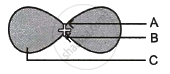
Name the parts labelled as A, B, C and D in the diagram given below:-

A student identified the various parts of an embryo of a gram seed and listed them as given below :
(I) Testa
(II) Plumule
(III) Radicle
(IV) Cotyledon
(V) Tegmen
Out of these the actual parts of the embryo are :
(A) I, II, III
(B) II, III, IV
(C) III, IV, V
(D) II, IV, V
Mature ovary forms the ______.
Explain the term 'fertilisation'.
Name the part of a seed which grows into shoot.
| When an insect sits on the flower of a plant then somene particles A present in the top of little stalks in the flower attach to its body hair. When this insect now sits on the flower of another similar plant, then particles A attached to the hair of insect are put on the top of a flask-shaped organ at the centre of flower. The particle A grows a long tube B from the top of flask-shaped organ through which C moves down and reaches the bottom part of flask-shaped organ. Here C fuses with the nucleus of D contained in structure E. The fusion of C and D forms a new cell F which grows and develops into a seed of the plant. |
- What are particles A? What is the process of transferring A from one flower to another flower of similar plant by the insect known as?
- What is the name of tube B?
- What is C which moves down through the tube B?
- Name D and E.
- What is F?
Draw a diagram of the longitudinal section of a flower exhibiting germination of pollen on stigma and label (i) ovary, (ii) male germ-cell, (iii) female germ-cell and (iv) ovule on it.
Fill in the blanks and rewrite the completed statements:
Lymph flows in _______________ direction.
What is meant by pollination?
In which of the following manner the arrangement of megaspores in a tetrad is observed in angiosperms?
The ovule of an angiosperm is technically equivalent to ______
Gloriosa superba exhibits ______.
What would be the number of chromosomes in the cells of the aleurone layer in a plant species with 8 chromosomes in its synergids?
Conidia are formed endogenously while zoospores are formed endogenously.
Which among the following statements are true for sexual reproduction in flowering plants?
- It requires two types of gametes
- Fertilisation is a compulsory event
- It always results in formation of zygote
- Offspring formed are clones
Give reason for the following:
Fertilization cannot take place in flowers if pollination does not occur.
Double fertilization means ______.
Sexual maturation of reproductive tissues and organs are necessary link for reproduction. Elucidate.
Consider the following three flowers namely X, Y and Z. Which flower(s) would develop into a fruit?
| Flower X | Flower Y | Flower Z |
 |
 |
 |
Given below is a diagram of a germinating seed. Label the parts that:
- gives rise to future shoot.
- gives rise to future root system.
- stores food.