Advertisements
Advertisements
प्रश्न
Give scientific reason.
Fertilization in plants is called double fertilization.
Advertisements
उत्तर
- The pollen grain germinates over the stigma and gives rise to pollen tube.
- The pollen tube bursts and releases two male gametes in the embryo sac.
- One male gamete fuses with the egg cell to form the zygote, whereas the second male gamete fuses with two polar nuclei in the embryo sac to form an endosperm.
- Since, in flowering plants, the process of fertilization occurs twice in the same embryo sac, by two male gametes, it is called as double fertilization.
APPEARS IN
संबंधित प्रश्न
In the following diagram showing the structure of embryo of a dicot seed, what are the parts marked I, II and III sequentially?

The anther contains ______.
Explain what you understand by sexual reproduction.
What is the name of female organ of a flower (other than carpel)?
Where is the female gamete formed in flowering plants?
Fill in the following blank with suitable word :
The ovary of a flower becomes ....... after fertilisation.
Fill in the following blank with suitable word :
The male organ of reproduction in the flower is the.......... .
Fill in the following blank with suitable word :
The name of the structure in the flower in which the male gamete is formed is...........
Fill in the following blank with suitable word :
The term used to refer to the transfer of pollen from the stamen of one flower to the carpel of another flower of the same species is...........
How do the insects help in cross-pollination?
Give some examples of different modes of fertilisation in nature?
Name the part of a seed which grows into root.
In the figure given alongside, the parts marked A, B and C are sequentially:
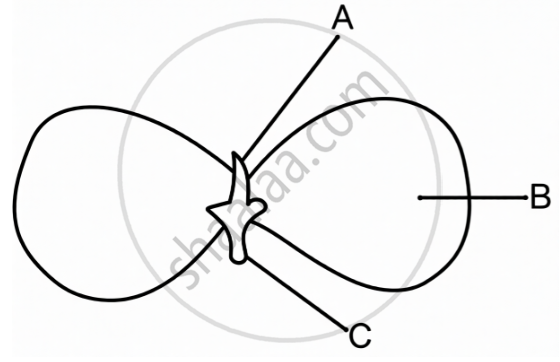
The part of a seed which grows and develops into root on germination is :
(a) cotyledon
(b) plumule
(c) follicle
(d) radicle
The flask-shaped organ A at the centre of a flower is surrounded by a number of little stalks B having swollen tops which lie just inside the ring of petals.
(a) Name A. What are the various parts of A?
(b) Which part of A contains gametes?
(c) Name B. What is the swollen top of B known as?
(d) What does the swollen top of b contain?
(e) Out of A and B, which one is (i) male part, and (ii) female part of the flower?
In what ways is fertilisation in a plant similar to fertilisation in a human?
What is a flower ? Draw a neat labelled diagram showing the L.S. of a typical flower.
Multiple choice question. Tick (✓) the correct choice:
The male gamete is present inside the which germinates.
- the style
- the stigma
- the anther
- the ovary
Find the odd-one out, giving reason:
Anther, pollen grain, ovule male gamete
Mention the function of Flower.
What are the male and female gametes in a flowering plant?
What part is played by stamens and carpels in reproduction?
A student is observing the temporary mount of a leaf peel under a microscope. Draw a labelled diagram of the structure of stomata as seen under the microscope
Answer the following question.
List two agents of pollination?
Find an odd one out.
Bisexual : Hibiscus : : Unisexual : ___________
Write the events involved in the sexual reproduction of a flowering plant.
Discuss the first event and write the types.
Write the events involved in the sexual reproduction of a flowering plant.
a. Discuss the first event and write the types.
b. Mention the advantages and the disadvantages of that event.
Which type of development is observed in male gametophytes of plants?
What would be the number of chromosomes in the cells of the aleurone layer in a plant species with 8 chromosomes in its synergids?
Pollen grains are produced by ______
Length of pollen tube depends on the distance between ______
Which among the following statements are true for unisexual flowers?
- They possess both stamen and pistil
- They possess either stamen or pistil
- They exhibit cross pollination
- Unisexual flowers possessing only stamens cannot produce fruits
Which among the following statements are true for sexual reproduction in flowering plants?
- It requires two types of gametes
- Fertilisation is a compulsory event
- It always results in formation of zygote
- Offspring formed are clones
In a bisexual flower inspite of the young stamens being removed artificially, the flower produces fruit. Provide a suitable explanation for the above situation.
Is the chromosome number of zygote, embryonal cells and adult of a particular organism always constant? How is the constancy maintained in these three stages?
Trace the path a male gamete takes to fertilise a female gamete after being released from the penis.
The pollen tube usually enters the embryo sac ______.
State the post-fertilisation changes that lead to fruit formation in plants.
