Advertisements
Advertisements
प्रश्न
Why does menstruation occur?
Advertisements
उत्तर
Menstruation is a process in which blood and mucous flow out every month through the vagina. This process occurs every month because one egg is released from the ovary every month and at the same time, the uterus (womb) prepares itself to receive the fertilised egg. Thus, the inner lining of the uterus gets thickened and is supplied with blood to nourish the embryo. If the egg does not get fertilised, then the lining of the uterus breaks down slowly and gets released in the form of blood and mucous from the vagina. It lasts for three to five days.
APPEARS IN
संबंधित प्रश्न
Name the function of the following:
Sperm tail
Mention the exact location of the following :
Amniotic fluid
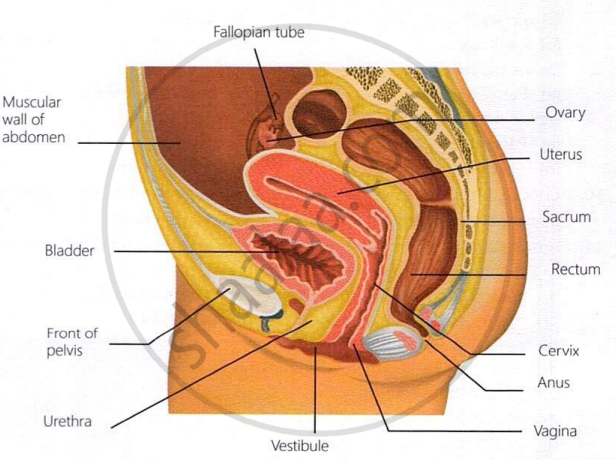
The diagram alongside is the vertical section of female reproductive organs. Study the diagram and answer the questions that follow:
- Name the fully developed part of ovary containing the ovum.
- Name the organ of the female body in which the foetus develops.
- What is ovulation?
- Which two hormones are secreted by ovary?
Complete the following statement by choosing the correct alternative:
Female copulatory organ ______.
Differentiate between the graafian follicle and corpus luteum.
The below diagram represents the vertical view of the human female reproductive system.
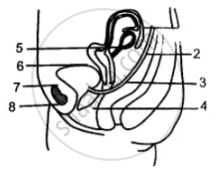
(i) Label the parts indicated by the guidelines 1 to 8.
(ii) How does the uterus prepare for the reception of a zygote?
(iii) What happens to the uterus if fertilization takes place?
(iv) What happens to the uterus if fertilization has failed to take place?
Write the functional activity of the following structure:
Fallopian tubes
Hormones secreted by the ovary of the female reproductive system.
Which of the following are accessory ducts of female reproductive system?
Penis is homologous to ____________.
All are internal genitalia in females. EXCEPT ______.
Which of the following statements regarding human reproduction is INCORRECT?
How many lobes are generally present in each mammary gland?
Which of the following is a finger like structure and lies at the upper junction of the two labia minora above the urethral opening?
Bartholin’s glands are situated ______.
Cleavage in mammalian egg is ______.
What marks the beginning of the reproductive life of a woman?
Fertilization occurs in human females when the sperms and ovum reach simultaneously at ______
Read the following and answer from given below:
Oogenesis is the process of the formation of an ovum in the ovaries. It consists of three phases: multiplication, growth, and maturation. Oogenesis is controlled by hormones GnRH, LH, FSH. GnRH secreted by the hypothalamus stimulates the anterior lobe of the pituitary gland to secrete LH and FSH.
what is the function of hormones FSH?
Which among the following diseases is not sexually transmitted?
Mother gives birth to a baby but the baby has characters of both parents. How is this possible?
Which is a pear-shaped muscular organ in females?
Female reproductive organs and associated functions are given below in column A and B. Fill the blank boxes.
| Column A | Column B |
| Ovaries | Ovulation |
| Oviduct | a |
| b | Pregnancy |
| Vagina | Birth |
Given below is a certain situation. Analyze and describe its possible impact on a person:
Egg is not fertilised in a human female.
Given below is a certain situation. Analyze and describe its possible impact on a person:
Placenta does not attach to the uterus optimally.
The ______ is also called the womb.
The ______ is also called the womb.
The ______ is also called the womb.
Write the specific location of the following:
Uterus
Median vertical depression of external genitalia in females, enclosing the urethral and vaginal opening is ______.
Which organs are the primary sex organs of the female reproductive system?
Female gametes, namely ova/ovum, are produced through which process?
Which ovarian hormone supports pregnancy?
Which part of the fallopian tube is the wider, curved middle section and the site of fertilisation?
What is the major role of the uterus in relation to the embryo?
At what age does puberty begin in females?
