Advertisements
Advertisements
प्रश्न
Name the part made up of the stigma, style and ovary.
Advertisements
उत्तर
Pistil contains stigma, style and ovary.
APPEARS IN
संबंधित प्रश्न
State significance of pollination.
State the function of flowers in the flowering plants.
The fusion of male and female gametes is termed as ______.
What are the reproductive organs in a flower?
What is the name of female part of a flower?
Fill in the following blank with suitable word :
Ovules contain ......... gametes of a plant.
Fill in the following blank with suitable word :
The ovary of a flower becomes ....... after fertilisation.
Fill in the following blank with suitable word :
The female organ of reproduction in the flower is the...........
What is made in anther of a flower?
Name the part of a seed which contains stored food.
In tobacco plant, the male gametes have 24 chromosomes.
What is the number of chromosomes in the female gamete?
The correct sequence of reproductive stages occurring in flowering plants is ______.
| When an insect sits on the flower of a plant then somene particles A present in the top of little stalks in the flower attach to its body hair. When this insect now sits on the flower of another similar plant, then particles A attached to the hair of insect are put on the top of a flask-shaped organ at the centre of flower. The particle A grows a long tube B from the top of flask-shaped organ through which C moves down and reaches the bottom part of flask-shaped organ. Here C fuses with the nucleus of D contained in structure E. The fusion of C and D forms a new cell F which grows and develops into a seed of the plant. |
- What are particles A? What is the process of transferring A from one flower to another flower of similar plant by the insect known as?
- What is the name of tube B?
- What is C which moves down through the tube B?
- Name D and E.
- What is F?
Multiple choice question. Tick (✓) the correct choice:
Unisexual flowers are found in
- mulberry
- mustard
- pea
- sunflower
Mention the function of Flower.
What part is played by stamens and carpels in reproduction?
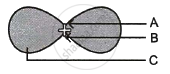
In the figure, the parts marked A, B and C are sequentially:

(A) Plumule, Radicle and Cotyledon
(B) Radicle, Plumule and Cotyledon
(C) Plumule, Cotyledon and Radicle
(D) Radicle, Cotyledon and Plumule
Write the names of male and female reproductive parts of a flower.
List any two differences between pollination and fertilization.
Identify the odd. Stigma, Style, Pollen, Ovary.
What is cleistogamy? Write one advantage and one disadvantage of it, to the plant.
Give scientific reason.
Fertilization in plants is called double fertilization.
Draw a neat and labelled diagram.
Double fertilization in angiosperms
The male reproductive part of a flower is ______.
The essential parts of a flower are ______.
Which of the following are the chemical components of the wall of pollen tube?
How many middle layers are generally present in the wall of the anther lobes?
Pineapple fruit develops from ______.
The flower of the Hibiscus plant is ______
Complete the table
| Carly x | ______ | ______ |
| ______ | petal | attract insects |
| Androecium | ______ | Male reproductive part |
| ______ | ______ | Female reproductive part. |
Give reason for the following:
Fertilization cannot take place in flowers if pollination does not occur.
Draw the diagram of a flower and label the four whorls. Write the names of gamete producing organs in the flower.
Trace the path a male gamete takes to fertilise a female gamete after being released from the penis.
What is the function of calyx?
The figure below shows the concept of double fertilization. Complete the flow chart showing the progress at each step:

Given below is a diagram of a germinating seed. Label the parts that:
- gives rise to future shoot.
- gives rise to future root system.
- stores food.