Advertisements
Advertisements
प्रश्न
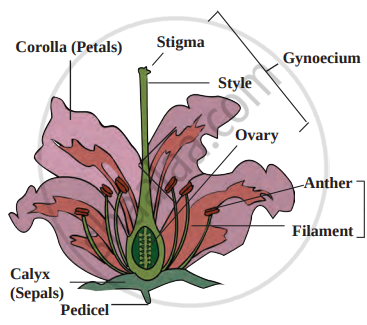
Sketch and label the essential and accessory whorls of flower.
Advertisements
उत्तर
संबंधित प्रश्न
Match the following:
| Column A | Column B |
| (i) Stigma | (a) Neuron |
| (ii) Pepsin | (b) Carpel |
| (iii) Dendrites | (c) Protein |
| (d) Stamen |
What is pollination?
Name the parts A, B and C shown in the following diagram and state one function of each.

Write the names of those parts of a flower which serve the same function as the following do in the animals :
(i) testis,
(ii) sperm,
(iii) ovary,
(iv) egg
Explain what you understand by sexual reproduction.
Where are a plant's sex organs located?
What is the name of female organ of a flower (other than carpel)?
Fill in the following blank with suitable word :
The male organ of reproduction in the flower is the.......... .
Draw a neat sketch of the carpel of a flower. Mark in it stigma, style and ovary.
What is made in anther of a flower?
Describe the process of fertilisation in a flower with the help of labelled diagrams.
The length of pollen tube depends on the distance between :
(a) pollen grain and upper surface of stigma
(b) pollen grain on upper surface of stigma and ovule
(c) pollen grain in anther and upper surface of stigma
(d) upper surface of stigma and lower part of style
Which of the following statements are true for sexual reproduction in flowering plants?
(i) it requires two types of gametes
(ii) fertilisation is a compulsory event
(iii) it always results in the formation of zygote
(iv) offsprings formed are clones
(a) (i) and (iv)
(b) (i), (ii) and (iv)
(c) (i), (ii) and (iii)
(d) (ii), (iii) and (iv)
The part of a seed which grows and develops into root on germination is :
(a) cotyledon
(b) plumule
(c) follicle
(d) radicle
The flask-shaped organ A at the centre of a flower is surrounded by a number of little stalks B having swollen tops which lie just inside the ring of petals.
(a) Name A. What are the various parts of A?
(b) Which part of A contains gametes?
(c) Name B. What is the swollen top of B known as?
(d) What does the swollen top of b contain?
(e) Out of A and B, which one is (i) male part, and (ii) female part of the flower?
| When an insect sits on the flower of a plant then somene particles A present in the top of little stalks in the flower attach to its body hair. When this insect now sits on the flower of another similar plant, then particles A attached to the hair of insect are put on the top of a flask-shaped organ at the centre of flower. The particle A grows a long tube B from the top of flask-shaped organ through which C moves down and reaches the bottom part of flask-shaped organ. Here C fuses with the nucleus of D contained in structure E. The fusion of C and D forms a new cell F which grows and develops into a seed of the plant. |
- What are particles A? What is the process of transferring A from one flower to another flower of similar plant by the insect known as?
- What is the name of tube B?
- What is C which moves down through the tube B?
- Name D and E.
- What is F?
Fill in the blank by selecting suitable word:
A flower that bears both the male and the female parts is known as __________ flower.
Multiple choice question. Tick (✓) the correct choice:
Unisexual flowers are found in
- mulberry
- mustard
- pea
- sunflower
Fill in the blank:
Seeds are formed from________.
Mention the function of Anther.
You have to perform the experiment, "To identify the different parts of an embryo of a gram seed." Describe the procedure that you would follow.
Identify A, B, C and D in the given diagram and write their names.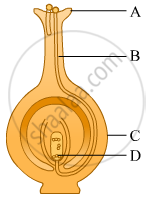
Explain the process of fertilisation in flowers.
Draw a diagram of a pistil showing pollen tube growth into the ovule and label the following:
Pollen grain, male gamete, female gamete, ovary.
Fill in the blanks and rewrite the completed statements:
Lymph flows in _______________ direction.
__________ is present in unisexual flower.
Find an odd one out.
Draw a neat and labelled diagram.
Double fertilization in angiosperms
Explain the sexual reproduction process in plants with a diagram.
The essential parts of a flower are ______.
What would be the number of chromosomes of the aleurone cells of a plant with 42 chromosomes in its roots tip cells?
Sperm and egg nuclei fuse due to ______.
In a bisexual flower inspite of the young stamens being removed artificially, the flower produces fruit. Provide a suitable explanation for the above situation.
Give any two examples of agents of pollination.
What is the function of calyx?
In flowering plants, the pollen grains are transferred to stigma by pollination but the female germ cells are present in the ovary.
Explain with the help of a labelled diagram (only concerned parts), how the male germ cell reaches the ovary.
- Assertion: Primary endosperm nucleus is diploid.
- Reason: It is the product of double fertilisation.
The number of pollen sacs in a dithecous anther is ______.
