Advertisements
Advertisements
प्रश्न
Observe the figure below. Write functions of the labelled parts.

Advertisements
उत्तर
- Gynoecium (Carpel): It is an essential whorl. It is consists of stigma, style and ovary. It acts as a female reproductive part of the flower. It is responsible for the production of female gametes.
- Androecium (Stamen): It is an essential whorl. It is consists of anther and filament. It acts as a male reproductive part of the flower. It is responsible for the production of male gametes.
- Calyx and corolla: Calyx and corolla are accessory whorls. They are responsible for the protection of inner (essential) whorls.
- Pedicel: Pedicel is a small stalk which supports the flower.
APPEARS IN
संबंधित प्रश्न
What is pollination?
Name the parts A, B and C shown in the following diagram and state one function of each.

Mention the changes a flower undergoes after fertilisation.
State the function of flowers in the flowering plants.
What are the reproductive organs in a flower?
What is the name of female part of a flower?
Fill in the following blank with suitable word :
The male organ of reproduction in the flower is the.......... .
Explain the term 'fertilisation'.
Name the part of a seed which grows into root.
Name the part of a seed which grows into shoot.
What changes take place in the flower after fertilisation which lead to the formation of seeds and fruit?
The length of pollen tube depends on the distance between :
(a) pollen grain and upper surface of stigma
(b) pollen grain on upper surface of stigma and ovule
(c) pollen grain in anther and upper surface of stigma
(d) upper surface of stigma and lower part of style
Which of the following statements are true for sexual reproduction in flowering plants?
(i) it requires two types of gametes
(ii) fertilisation is a compulsory event
(iii) it always results in the formation of zygote
(iv) offsprings formed are clones
(a) (i) and (iv)
(b) (i), (ii) and (iv)
(c) (i), (ii) and (iii)
(d) (ii), (iii) and (iv)
The correct sequence of reproductive stages occurring in flowering plants is ______.
Fill in the blank by selecting suitable word:
A flower bearing only male or female parts is known as __________ flower.
State whether the following statement is true (T) or false (F):
Flowers which possess stamens and carpel are called unisexual.
What part is played by stamens and carpels in reproduction?
Identify A, B, C and D in the given diagram and write their names.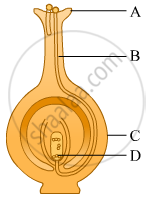
Write the names of male and female reproductive parts of a flower.
List any two differences between pollination and fertilization.
Explain sexual reproduction in plants.
What is cleistogamy? Write one advantage and one disadvantage of it, to the plant.
Answer the following question.
List two agents of pollination?
Pollen tube reaches the embryo sac via style.
Write the events involved in the sexual reproduction of a flowering plant.
Discuss the first event and write the types.
Write the events involved in the sexual reproduction of a flowering plant.
a. Discuss the first event and write the types.
b. Mention the advantages and the disadvantages of that event.
The anther wall consists of four wall layers where ______
In which of the following manner the arrangement of megaspores in a tetrad is observed in angiosperms?
Generally, in a pollen tube, which of the following moves to the tip of the tube?
How many middle layers are generally present in the wall of the anther lobes?
Which type of development is observed in male gametophytes of plants?
The flower of the Hibiscus plant is ______
Variations occur as a result of ______
Which out of the following processes does not lead to the formation of clones.
Is the chromosome number of zygote, embryonal cells and adult of a particular organism always constant? How is the constancy maintained in these three stages?
What are the agents for pollination?
Type of sexual reproduction is ______.
Consider the following three flowers namely X, Y and Z. Which flower(s) would develop into a fruit?
| Flower X | Flower Y | Flower Z |
 |
 |
 |
