Advertisements
Advertisements
Question
Describe the development of a fertilized ovum upto implantation.
Advertisements
Solution
Development of fertilized ovum upto implantation:
Fertilisation results in the formation of a diploid zygote. The zygote formed after fertilization undergoes mitosis. Mitosis takes place in the isthmus of the oviduct or the fallopian tube. This process is known as cleavage. The cleavage results in the formation of 2, 4, 8, 16 daughter cells that are called blastomeres. The 8−16 blastomeres is called a morula, which continues to divide to form the blastocyst. The morula moves further into the uterus. The cells in the blastocyst are arranged into an outer trophoblast and an inner cell mass. The trophoblast gets attached to the uterine endometrium, and the process is called implantation. This leads to pregnancy.

APPEARS IN
RELATED QUESTIONS
Put a tick mark (✓) against the correct alternative in the following statement:
Internally, the uterus opens into:
Given here is a section of the female reproductive system of human beings.
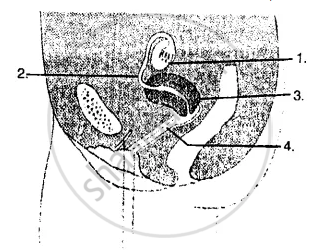
Name the parts labelled 1 to 4
Give appropriate term of the following:
The process of fusion of ovum and sperm.
Given here is a section of the female reproductive system of human beings.
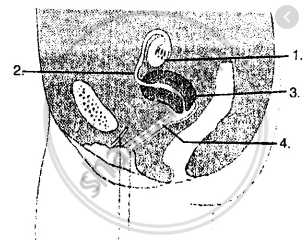
Name the part where fertilisation occurs in human beings.
Estrogen is secreted by ______
Womb is used to refer ______.
Read the following and answer from given below:
Oogenesis is the process of the formation of an ovum in the ovaries. It consists of three phases: multiplication, growth, and maturation. Oogenesis is controlled by hormones GnRH, LH, FSH. GnRH secreted by the hypothalamus stimulates the anterior lobe of the pituitary gland to secrete LH and FSH.
Identify the functions of LH.
- Release of a secondary oocyte from Graafian follicle.
- Stimulates corpus luteum to secrete progesterone.
- Stimulates estrogen formation.
- Promotes development of egg to form secondary oocyte.
Which combination correctly identifies the stroma zones of the ovary?
From where does each fallopian tube extend?
What is formed when tubules of each mammary lobe join?
