Advertisements
Advertisements
प्रश्न
What are the accessory reproductive organs?
थोडक्यात उत्तर
Advertisements
उत्तर
- The accessory reproductive organs include all those structures, ducts, and glands that help in the transfer and meeting of the two kinds of sex cells, leading to fertilisation, and in the growth and development of the egg up to the birth of the baby.
- Female reproductive organs include the uterus, vagina, and fallopian tubes, rather than accessory reproductive organs.
- Females' mammary glands provide milk to nurture their infants after birth.
- The male accessory reproductive organs are the seminal vesicles and prostate gland.
- Female accessory reproductive organs are the mammary glands (for breastfeeding) and fallopian tubes (oviducts).
shaalaa.com
या प्रश्नात किंवा उत्तरात काही त्रुटी आहे का?
पाठ 13: The Reproductive System - Review Questions [पृष्ठ १९४]
APPEARS IN
संबंधित प्रश्न
Mention the functions of Testis.
Given below is the schematic diagram of the sectional view of the human male reproductive system.
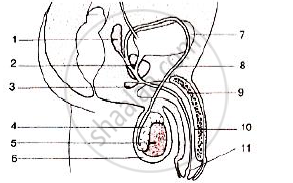
Name the parts numbered 1-11.
State the Location:
Seminal vesicle
Identify the INCORRECTLY labelled structure in the given diagram of the male reproductive system.
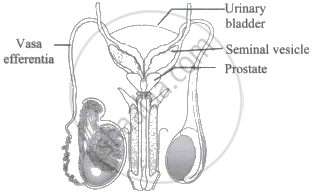
Fructose is found in secretion of ______.
Seminal plasma in human males is rich in ______.
Vasa efferentia exist in between:
Sketch and label Human Male Reproductive System.
Choose the odd one out from the group of terms given below and write the category for the remaining terms:
Each testis is divided into approximately how many compartments called testicular lobules?
