Advertisements
Online Mock Tests
Chapters
1: Cell: The structural and functional unit of life
2: Structure of chromosome, cell cycle and cell division
▶ 3: Genetics: Some Basic Fundamentals
Unit-2 : Plant Physiology
4: Absorption by roots: The Processes Involved
5: Transpiration
6: Photosynthesis
7: Chemical Coordination in Plants
Unit-3 : Human Anatomy and Physiology
8: The Circulatory System
9: The Excretory System
10: The Nervous System
11: Sense Organs
12: The Endocrine System
13: The Reproductive System
Unit-4 : Human Evolution
14: Human Evolution
Unit-5 : Population
15: Population: The increasing numbers and rising problems
Unit-6 : Pollution
16: Pollution: A Rising Environmental Problem
![Selina solutions for कन्साइस बायोलॉजी [इंग्रजी] इयत्ता १० आयसीएसई chapter 3 - Genetics: Some Basic Fundamentals - Shaalaa.com](/images/concise-biology-english-class-10-icse_6:930ad8471f2d4b8b8e0d2fbdad788b1f.jpg "Selina solutions for कन्साइस बायोलॉजी [इंग्रजी] इयत्ता १० आयसीएसई chapter 3 - Genetics: Some Basic Fundamentals")
Advertisements
Solutions for Chapter 3: Genetics: Some Basic Fundamentals
Below listed, you can find solutions for Chapter 3 of CISCE Selina for कन्साइस बायोलॉजी [इंग्रजी] इयत्ता १० आयसीएसई.
Selina solutions for कन्साइस बायोलॉजी [इंग्रजी] इयत्ता १० आयसीएसई 3 Genetics: Some Basic Fundamentals Progress Check [Page 25]
Mention if the following statement is True (T) or False (F):
are the same thing.
T
F
Mention if the following statement is True (T) or False (F):
“Like begets like”, this applies only to animals.
T
F
Mention if the following statement is True (T) or False (F):
The entire human population shows variations.
T
F
Which of the following in humans are established genetic traits? (Tick-mark the correct ones) in the box provided.
- Capacity to be a good cricketer \[\ce{\square{}}\]
- Curly hair \[\ce{\square{}}\]
- Left-handedness \[\ce{\square{}}\]
- Quality of voice \[\ce{\square{}}\]
- Red-green colour blindness \[\ce{\square{}}\]
Selina solutions for कन्साइस बायोलॉजी [इंग्रजी] इयत्ता १० आयसीएसई 3 Genetics: Some Basic Fundamentals Progress Check [Page 27]
Mention the following:
Total number of pairs of chromosomes in each body cell in humans.
Mention the following:
Number of pairs of autosomes in one cell of humans.
A certain couple got only four daughters in a row and no son. Does it mean that the husband does not produce Y-bearing sperms? Explain.
Selina solutions for कन्साइस बायोलॉजी [इंग्रजी] इयत्ता १० आयसीएसई 3 Genetics: Some Basic Fundamentals Progress Check [Page 32]
Name the following:
The basic units of heredity.
Define the following:
Allele
Define the following term:-
Dominant gene
Define the following:
Genotype
Define the following:
Phenotype
Define the following term:-
Recessive gene
Mention the number of paired homozygous chromosomes in human female.
Mention the number of paired homozygous chromosomes in human male.
Can there be a heterozygous recessive? Explain.
List any four characters along with their traits in humans which you can easily study just by observing and making family charts.
Selina solutions for कन्साइस बायोलॉजी [इंग्रजी] इयत्ता १० आयसीएसई 3 Genetics: Some Basic Fundamentals Progress Check [Page 35]
Who discovered for the first time the basic principles of genetics?
Give the common and scientific names of the organism on which Gregor Mendel had worked.
Differentiate Between Monohybrid and Dihybrid cross.
Distinguish between the following pair:
Genotype and Phenotypе
Differentiate between character and trait.
Distinguish between the following pair:
Dominant and Recessive Allele
Distinguish between the following pair:
Autosomes and Sex chromosomes
Write two characters of pea pod with their alternative traits.
Selina solutions for कन्साइस बायोलॉजी [इंग्रजी] इयत्ता १० आयसीएसई 3 Genetics: Some Basic Fundamentals Review Questions [Pages 36 - 38]
MULTIPLE CHOICE TYPE
Which one of the following is the phenotypic monohybrid ratio in F2 generation?
3 : 1
1 : 2 : 1
2 : 2
1 : 3
If a pure tall plant is crossed with a pure dwarf plant, then offspring will be ______.
all tall
all dwarf
3 tall 1 dwarf
50% tall 50% dwarf
The 9 : 3 : 3 : 1 dihybrid ratio is due to ______.
segregation
crossing over
independent assortment
homologous pairing
A plant with green pods and smooth seeds with the genotype Ggss will give rise to the following gametes:
Gg and Ss
Gs and ss
Gs and gs
Gg and gs
The disease colour blindness is a ______.
Recessive X-linked disease
Dominant Y-linked disease
Recessive Y-linked disease
Dominant X-linked disease
The physical expression of a character is called ______.
Genotype
Alleles
Phenotype
Traits
Purity of gametes is linked to ______.
Law of dominance
Law of independent assortment
Law of segregation
Law of limiting factor
The phenotypic dihybrid ratio of F2 generation is ______.
9 : 3 : 1 : 1
9 : 1 : 3 : 1
9 : 1 : 3 : 3
9 : 3 : 3 : 1
In the human male, a sperm contains autosomes and ______.
X and Y chromosomes
Only X chromosome
X or Y chromosome
Only Y chromosome
If the mother is normal and the father is haemophilic, then their two daughters will be ______.
Normal
Haemophilic
Carrier
None
Susheel, a colourblind man, is married to Susheela, a woman with normal vision. Which of the following combinations would be possible in their children?
Colourblind daughters and colourblind sons.
Normal daughters and normal sons.
Carrier daughters and normal sons.
Carrier daughters and colourblind sons.
Assertion (A): Heredity is the basic fundamental unit of Genetics.
Reason (R): Genes carry hereditary information from the offsprings to their parents.
A is True and R is False.
A is False and R is True.
Both A and R are True.
Both A and R are False.
Assertion (A): Karyotype is the division of nucleus during cell-division.
Reason (R): Karyon means nucleus and type explains the number, shape and size of the chromosome.
A is True and R is False.
A is False and R is True.
Both A and R are True.
Both A and R are False.
Assertion (A): Dominant alleles can express themselves only in homozygous condition.
Reason (R): Dominant alleles support recessive alleles and allow them to express, even in heterozygous condition.
A is True and R is False.
A is False and R is True.
Both A and R are True.
Both A and R are False.
Assertion (A): Genotype is the genetic make up of a cell.
Reason (R): Phenotype is the set of genes present in the cells of an organism that expresses internal characters.
A is True and R is False.
A is False and R is True.
Both A and R are True.
Both A and R are False.
Assertion (A): A daughter can resemble only her mother and not her father.
Reason (R): Sex chromosomes of the daughter (XX) are received from both the parents.
A is True and R is False.
A is False and R is True.
Both A and R are True.
Both A and R are False.
VERY SHORT ANSWER TYPE.
Match the terms in column I with their explanations in column II.
| Column I (Term) | Column I (Explanation) | ||
| a | genetics | 1 | Chromosomes similar in size and shape |
| b | Autosomes | 2 | The alternative forms of a gene |
| c | Recessive gene | 3 | Study of laws of inheritance of characters |
| d | Allele | 4 | A gene that can express only when in a similar pair |
| e | Homologous chromosomes | 5 | Chromosomes other than the pair of sex chromosomes |
Name any two genetic diseases in humans.
Which one of the following genotypes is homozygous dominant and which one homozygous recessive in regards to tongue rolling:
SHORT ANSWER TYPE
Rewrite the correct form of the statement by changing the first or last word only:
Duplicated chromosomes remain attached at a point termed as centrosome.
Rewrite the correct form of the statement by changing the first or last word only:
The full complement of DNA of an organism is termed as genetics.
Rewrite the correct form of the statement by changing the first or last word only:
The inheritable feature of an organism is termed as heredity.
Rewrite the correct form of the statement by changing the first or last word only:
Terminal flower position is a dominant trait of pea flower.
Rewrite the correct form of the statement by changing the first or last word only:
Alternative forms of a gene are called traits.
Among lion, tiger and domestic cat, all three have the same number of 38 chromosomes, yet they have different appearances. How do you account for such differences ?
List any three features of garden pea with their dominant and recessive traits.
Explain why generally only the male child suffers from colour blindness and not the female?
DESCRIPTIVE TYPE
Define the following term:
Pedigree chart
Define the following term:
Variations
Define the term Mutation.
State the three Mendel’s laws of inheritance.
Does the sex of the child depend on the father or it is just a matter of chance? Discuss.
Distinguish between the following pair:
Karyotype and Karyokinesis
Distinguish between the following pair:
Autosomes and Sex chromosomes
Distinguish between the following pair:
Homozygous and Heterozygous chromosomes
STRUCTURED/APPLICATION AND SKILL TYPE
In a certain species of animals, black fur (B) is dominant over brown fur (b) Predict the genotype and phenotype of the offspring when both parents are ‘Bb’ or have heterozygous
black fur .
Two pairs (A & B) of rabbits were crossed, as given below:

- Can you tell which coat colour (black or white) is dominant?
- Is the coat colour sex-linked?
Make a Punnett square and find out the genotypic and phenotypic ratios of F2 generation in the progeny of a genetic cross between:
- A pure tall (TT) pea plant with a pure dwarf (tt) pea plant.
- Red flower variety of pea (RR) with white flower variety of pea (rr).
Mendel crossed a homozygous pea plant having round seeds (RR) with a homozygous pea plant having wrinkled seeds (rr). He got different results. On the basis of it, answer the following questions:
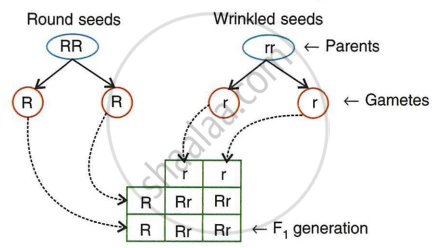
- Which character of seed is studied in the experiment?
- Which of the above two traits is dominant?
- Write the phenotype and genotype of F1 offspring.
- Mention and state Mendel's law as shown in the above cross.
- Make a Punnett square for F2 generation when two plants of F1 offspring are crossed with each other.
- Write the phenotypic ratio of F2 progeny.
- What will be the genotypic ratio of F2 offspring?
- What are the two traits of seed colour ? Also mention which is dominant and recessive?
- Write the scientific name of the garden pea.
- Write two main features of the pea plant, due to which Mendel selected it for his hybridisation studies.
A homozygous plant having round (R) and yellow (Y) seeds is crossed with another homozygous plant having wrinkled (r) and green (y) seeds. Answer the following questions:
- Give the genotype of the F1 generation.
- Mention the phenotype of the F1 offspring.
- Give the possible combinations of gametes that can be obtained from F1 hybrids.
- Give the dihybrid phenotypic ratio and the phenotype of the offspring of the F2 generation when two plants of F1 generation are crossed.
- Name and state the law which explains the dihybrid phenotypic ratio.
Solutions for 3: Genetics: Some Basic Fundamentals
Selina solutions for कन्साइस बायोलॉजी [इंग्रजी] इयत्ता १० आयसीएसई chapter 3 - Genetics: Some Basic Fundamentals
Shaalaa.com has the CISCE Mathematics कन्साइस बायोलॉजी [इंग्रजी] इयत्ता १० आयसीएसई CISCE solutions in a manner that help students grasp basic concepts better and faster. The detailed, step-by-step solutions will help you understand the concepts better and clarify any confusion. Selina solutions for Mathematics कन्साइस बायोलॉजी [इंग्रजी] इयत्ता १० आयसीएसई CISCE 3 (Genetics: Some Basic Fundamentals) include all questions with answers and detailed explanations. This will clear students' doubts about questions and improve their application skills while preparing for board exams.
Further, we at Shaalaa.com provide such solutions so students can prepare for written exams. Selina textbook solutions can be a core help for self-study and provide excellent self-help guidance for students.
Concepts covered in कन्साइस बायोलॉजी [इंग्रजी] इयत्ता १० आयसीएसई chapter 3 Genetics: Some Basic Fundamentals are Gregor Johann Mendel – Father of Genetics, Genes and Genetic, Sex Determination, Genes and their Alleles, Genotype and Phenotype, Autosomes and Sex Chromosomes, Sex-Linked Inheritance in Human Beings, Inheritance in Humans, Monohybrid Cross, Inheritance of Human Traits and Their Genetic Basis, Applications and Beyond Mendel's Laws, Gregor Johann Mendel – Father of Genetics, Genes and Genetic, Sex Determination, Genes and their Alleles, Genotype and Phenotype, Autosomes and Sex Chromosomes, Sex-Linked Inheritance in Human Beings, Inheritance in Humans, Monohybrid Cross, Inheritance of Human Traits and Their Genetic Basis, Applications and Beyond Mendel's Laws, Gregor Johann Mendel – Father of Genetics, Genes and Genetic, Sex Determination, Genes and their Alleles, Genotype and Phenotype, Autosomes and Sex Chromosomes, Sex-Linked Inheritance in Human Beings, Inheritance in Humans, Monohybrid Cross, Inheritance of Human Traits and Their Genetic Basis, Applications and Beyond Mendel's Laws.
Using Selina कन्साइस बायोलॉजी [इंग्रजी] इयत्ता १० आयसीएसई solutions Genetics: Some Basic Fundamentals exercise by students is an easy way to prepare for the exams, as they involve solutions arranged chapter-wise and also page-wise. The questions involved in Selina Solutions are essential questions that can be asked in the final exam. Maximum CISCE कन्साइस बायोलॉजी [इंग्रजी] इयत्ता १० आयसीएसई students prefer Selina Textbook Solutions to score more in exams.
Get the free view of Chapter 3, Genetics: Some Basic Fundamentals कन्साइस बायोलॉजी [इंग्रजी] इयत्ता १० आयसीएसई additional questions for Mathematics कन्साइस बायोलॉजी [इंग्रजी] इयत्ता १० आयसीएसई CISCE, and you can use Shaalaa.com to keep it handy for your exam preparation.
