Advertisements
Advertisements
Question
The diagram given below is that of a developing human foetus. Study the diagram and then answer the questions that follow:
- Label the parts numbered 1 to 3 in the diagram.
- Mention any two functions of the part labelled 2 in the diagram.
- Explain the significance of the part numbered 3 in the diagram.
- Define the term ‘Gestation’. What is the normal gestational period of the developing human embryo?
- Mention the sex chromosomes in a male and female embryo.

Advertisements
Solution
-
- Umbilical cord
- Placenta
- Amniotic fluid
- Functions of placenta:
- It allows the diffusion of oxygen, nutrients and immune products from the mother to the foetus.
- It allows the diffusion of waste material generated by the foetus to the mother for excretion.
- Functions of amniotic fluid:
- The amniotic fluid prevents the foetus from injury and shocks.
- It allows the foetus some amount of movement.
- It prevents the amnion from sticking to the foetus.
- It maintains an even pressure all around the foetus.
- Gestation:
- The time period required for the development of the foetus inside the uterus is called gestation.
- The normal gestation period in humans is 280 days (9 months).
- Male sex chromosomes:
- One ‘X’ chromosome and one ‘Y’ chromosome (XY).
- Female sex chromosomes: Two ‘X’ chromosomes (XX).
APPEARS IN
RELATED QUESTIONS
State the main function of the Leydig cells
The site of maturation of human sperms is the
Where is the female gamete formed in humans?
Which part of the human body produces ova?
Draw a diagram to display the vertical view of human female reproductive system and label the following parts in the diagram:
(1) Ureter
(2) Ovary
(3) Funnel of fallopian tube
(4) Urethra.
Define the four stages in the uterine cycle.
Differentiate
Urinogenital system and Urinary system.
Choose the Odd One Out:
The following is the illustration of the sequence of ovarian events (a-i) in a human female.
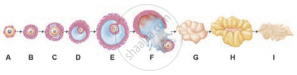
Write the difference between C and H.
Humans are classified as which type of reproducing organisms based on their mode of reproduction?
