Advertisements
Online Mock Tests
Chapters
1: Cell Division
2: Structure of Chromosomes
3: Principles of Genetics
Unit-2 Plant Physiology
4: Absorption by Roots
5: Transpiration
6: Photosynthesis
▶ 7: Chemical Coordination in Plants
8: Circulatory System
Unit-3 Human Anatomy and Physiology
9: Excretory System
10: Nervous System
11: Endocrine System
12: Reproductive System
13: Human Population
14: The Evolution of Man
15: Theories of Evolution
16: Types of Pollution
17: Sources of Pollution and Major Pollutants
18: Effects of Pollution
19: Abatement of Pollution
20: Greenhouse Effects, Global Warming, Ozone Layer Depletion and Acid Rain
![Frank solutions for Biology Part 2 [English] Class 10 ICSE chapter 7 - Chemical Coordination in Plants - Shaalaa.com](/images/biology-part-2-english-class-10-icse_6:4cd9978ddb1c4f42b0b0e9ec6f09c057.jpg "Frank solutions for Biology Part 2 [English] Class 10 ICSE chapter 7 - Chemical Coordination in Plants")
Advertisements
Solutions for Chapter 7: Chemical Coordination in Plants
Below listed, you can find solutions for Chapter 7 of CISCE Frank for Biology Part 2 [English] Class 10 ICSE.
Frank solutions for Biology Part 2 [English] Class 10 ICSE 7 Chemical Coordination in Plants Exercises [Pages 99 - 103]
Choose the correct alternative from the choices given below each statement.
Avena coleoptile test to find out the quantity of growth promoting hormones was discovered by ______.
F.W. Went
L.J. Oudus
K.V. Thimann
F. Skoog
Indole-3 acetic acid, called as auxin was first isolated from ______.
Human urine
Corn germ oil
Fusarium
Rhizopus
Which of the following effects of auxins is of wide application?
induction of fruit development
induction of root initiation
prevention of abscission
all of these
Growth hormone acts ______.
always as growth promoters.
always as growth inhibitors.
some as promoters and some as inhibitors.
rarely as growth inducers.
Gibberellin was first extracted from ______.
Gibberella fujikuroi
Gellidium
Gracillaria
Aspergillus
Bolting hormone is ______.
Auxin
Gibberellin
ABA
Ethylene
Gibberellins are ______.
growth inhibitors
growth promoters
not concerned with growth at all
of little potential in agriculture
Gibberellin was first isolated from culture of ______.
an alga
a fungus
a bacteria
an actinomycetes
Genetically dwarf plants can be made long by the application of ______.
Auxins
Cytokinins
Gibberellins
Vernalin
Which of the following growth hormones can be used for the eradication of weeds?
IAA
IBA
2, 4-D
Cytokinin
The curvature of coleoptile towards the source of light is due to ______.
Enlargement of the cell on the illuminated side.
Enlargement of the cell on the shaded side.
Enlargement of the cells on both sides.
No enlargement.
Sprouting of potato during storage can be prevented by ______.
IAA
Cytokinins
Gibberellins
Maleic hydrazide
Apparatus used to nullify the effect of geotropism is known as ______.
Auxanometer
Clinostat
Hydrostat
Potometer
The most common cytokinin is ______.
IAA
Kinetin
Isopentenyl adenine
Dihydrozeatin
The growth regulator that retards ageing of plant organ is ______.
Auxin
Gibberellin
Cytokinin
Abscisic acid
Hormone responsible for senescence is ______.
ABA
Auxin
GA
Cytokinin
Movement of pollen tube is an instance of ______.
Chemotropism
Hydrotropism
Phototropism
None of these
Coiling of garden pea tendrils around any support is an example of ______.
Thigmotaxis
Thigmonasty
Thigmotropism
Thermotaxis
‘Foolish seedling disease’ of rice led to the discovery of ______.
IAA
GA
IBA
2,4-D
Phototropic curvature is the result of uneven distribution of ______.
Gibberellins
Phytochrome
Cytokinins
Auxin
Which is a stress hormone?
Benzyl aminopurine
DAA
Ethylene
Abscisic acid
Among the following which helps in early ripening of fruits?
Methane
Ethylene
CO2
CO
Movement of roots in search of moisture is called ______.
geotropism
thigmotropism
phototropism
hydrotropism
Following questions consist of two statements - Assertion (A) and Reason (R). Answer these questions by selecting the appropriate option given below:
Assertion (A): The effect of auxin hormone on the growth of roots exactly opposite to that on a stem.
Reason (R): Auxin hormone increases the rate of growth in root and decreases the rate of growth in stem.
Both A and R are true and R is the correct explanation of A.
Both A and R are true but R is not the correct explanation of A.
A is true but R is false.
A is false but R is true.
Assertion (A): Auxins promote the elongation of cells.
Reason (R): Auxins stimulate cell division in the short apical meristem.
Both A and R are true and R is the correct explanation of A.
Both A and R are true but R is not the correct explanation of A.
A is true but R is false.
A is false but R is true.
Assertion (A): Phototropism is caused by auxin.
Reason (R): When light is coming frem one side of the plant, auxin diffuses towards the shady side of the shoot.
Both A and R are true and R is the correct explanation of A.
Both A and R are true but R is not the correct explanation of A.
A is true but R is false.
A is false but R is true.
Name the plant hormone associated/concerned with the following:
Elongation of cell
Name the plant hormone associated/concerned with the following:
Shedding of leaves
Name the plant hormone associated/concerned with the following:
Breaking seed dormancy
Name the plant hormone associated/concerned with the following:
The only gaseous plant regulator
Name the plant hormone associated/concerned with the following:
A growth inhibitor in plants
Name the following:
A gaseous plant hormone which promotes the ripening of fruits.
Name the following:
The tropic movement of plant parts in response to chemicals.
Write short notes on:
Cytokinins
Write a short note on:
Phototropism
Write a short note on:
Geotropism
Write a short note on:
Ethylene
Name the type of movement induced in plants by light.
Name the type of movement induced in plants by gravity.
Name the type of movement induced in plants by moisture.
Which one of the plant growth regulators would you use if you are asked to:
Induce rooting in a twig
Which one of the plant growth regulators would you use if you are asked to:
Quickly ripen a fruit
Which one of the plant growth regulators would you use if you are asked to:
Delay leaf senescence
Which one of the plant growth regulators would you use if you are asked to:
Induce growth in axillary buds
Mention any two physiological effects of auxins.
Distinguish between phototropism and geotropism.
Name the part of plant which shows positive geotropism. Why?
Write full form of 2,4-D
Mention one use of 2,4-D.
Name five main classes of plant hormones.
Define plant movement.
How is movement in plants different from that in animals?
Abscisic acid is a growth inhibiting hormone. How is it useful to plants?
Write the main functions of gibberellins.
What is a growth regulator?
Give a brief account of auxins.
What are the major differences among auxins and gibberellins?
What do you know about the role of ġibberellin in plant growth?
Write a short note on foolish seedling disease.
Write a short note on senescence.
Write a short note on abscission of leaf.
Write a short note on phytohormones.
How were gibberellins discovered?
Write the main applications of gibberellins in plants.
Write short notes on:
Thigmotropism
Write short notes on:
Chemotropism
Write short notes on:
Hydrotropism
Give biological explanations for Plants growing in fertilized soil are often found to wilt if the soil is not adequately watered.
What is Parthenocarpy?
Give one example of Parthenocarpy.
The diagram given below represents a plant movement. Answer the following questions.
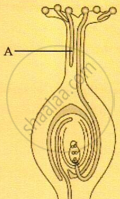
- Name the tropic movement shown in the diagram.
- Explain the tropic movement mentioned in (a).
- Label the part marked ‘A’.
- What is part A attracted to?
- Give an example of a plant which shows thigmotropism.
Given below is an experimental setup to demonstrate a particular tropic movement in germinating seeds. Study the diagram and answer the questions that follow:
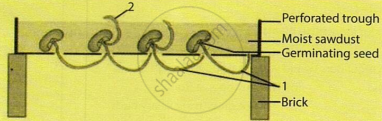
- Label the parts 1 and 2.
- Name the tropic movement shown by part 1.
- Part 1 is affected by two stimuli. Name them. Which one of the two is stronger?
- What is thigmotropism? Give one example.
- What is meant by 'Positive' and 'Negative' tropic movements in plants?
Study the diagram given below and answer the questions that follow:
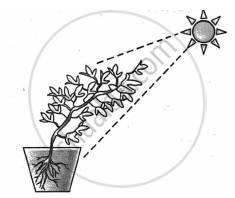
- Name the phenomenon depicted by the shoot in the above diagram.
- Which plant hormone plays an important role in the above movement?
- Complete and rewrite the given statement by filling in the correct terms:
Shoots show positive ______ whereas, roots show positive ______.
Ali has some pea plants in his garden which need a support to grow as seen in the picture given below:

- Name the phenomenon depicted by the shoot in the given figure.
- Define the above phenomenon.
- Write the name of the part marked X.
Solutions for 7: Chemical Coordination in Plants
Frank solutions for Biology Part 2 [English] Class 10 ICSE chapter 7 - Chemical Coordination in Plants
Shaalaa.com has the CISCE Mathematics Biology Part 2 [English] Class 10 ICSE CISCE solutions in a manner that help students grasp basic concepts better and faster. The detailed, step-by-step solutions will help you understand the concepts better and clarify any confusion. Frank solutions for Mathematics Biology Part 2 [English] Class 10 ICSE CISCE 7 (Chemical Coordination in Plants) include all questions with answers and detailed explanations. This will clear students' doubts about questions and improve their application skills while preparing for board exams.
Further, we at Shaalaa.com provide such solutions so students can prepare for written exams. Frank textbook solutions can be a core help for self-study and provide excellent self-help guidance for students.
Concepts covered in Biology Part 2 [English] Class 10 ICSE chapter 7 Chemical Coordination in Plants are Auxins, Gibberellins, Cytokinins, Ethylene, Abscisic Acid (ABA), Plant Hormones, Tropic Movements in Plants, Phototropism, Geotropism, Hydrotropism, Thigmotropism, Chemotropism.
Using Frank Biology Part 2 [English] Class 10 ICSE solutions Chemical Coordination in Plants exercise by students is an easy way to prepare for the exams, as they involve solutions arranged chapter-wise and also page-wise. The questions involved in Frank Solutions are essential questions that can be asked in the final exam. Maximum CISCE Biology Part 2 [English] Class 10 ICSE students prefer Frank Textbook Solutions to score more in exams.
Get the free view of Chapter 7, Chemical Coordination in Plants Biology Part 2 [English] Class 10 ICSE additional questions for Mathematics Biology Part 2 [English] Class 10 ICSE CISCE, and you can use Shaalaa.com to keep it handy for your exam preparation.
