Advertisements
Advertisements
Question
Study the diagram given below and answer the questions that follow:
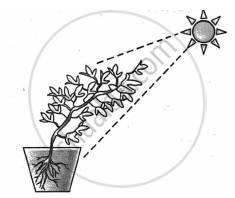
- Name the phenomenon depicted by the shoot in the above diagram.
- Which plant hormone plays an important role in the above movement?
- Complete and rewrite the given statement by filling in the correct terms:
Shoots show positive ______ whereas, roots show positive ______.
Advertisements
Solution
- Phototropism of plant.
- Auxin hormone.
- Shoots show positive phototropism whereas, roots show positive geotropism.
RELATED QUESTIONS
How does chemical coordination occur in plants?
What is the general name of chemical substances which bring about control and coordination in plants?
Auxins are abundantly produced in
The tea plants are never allowed to grow lengthwise. This is done by cutting their apical buds, a process known as pruning. In this way, tea plants get a dense growth and easy yield. Answer the following question :
What plant hormone is responsible for the scientific phenomenon mentioned in 1.1.
The figure given below shows the stages of ripening in a banana. Answer the question that follow:

Mention two characteristic features of this hormone.
Very Short Answer Question:
Which is the plant stress hormone?
Write full form of 2,4-D
Which among the following is the CORRECT statement regarding ethylene?
Identify the INCORRECT statement regarding physiological effects of ethylene.
The only phytohormone which is a gas at ordinary temperature:
